**Key Takeaway, ** A full bathroom remodel in Columbia, MD costs $18,000–$35,000 for a mid-range project in 2026, with cosmetic refreshes from $8,000 and luxury primary baths reaching $75,000+. Most projects take 3–6 weeks on site, and Howard County requires a permit for any remodel that moves plumbing or electrical. GBC Kitchen & Bath serves all of Columbia from its 5.0-star Berger Road showroom.
Columbia is not a typical remodeling market. Most of the city was built in planned waves, village by village, from the late 1960s through the 1990s, which means thousands of Howard County homes are now living with bathrooms that are 30, 40, even 50 years into their service life. Original cast-iron tubs, builder-grade oak vanities, 4x4 almond tile, and exhaust fans that were undersized the day they were installed: if this sounds like your hall bath, you’re in the majority here.
This guide covers everything a Columbia homeowner needs to plan a bathroom remodel in 2026, real local costs by tier and bathroom size, Howard County’s permit rules, realistic timelines, what’s worth splurging on, what’s specific to Columbia’s housing stock, and how to choose a contractor you’ll still be happy with a year later.
Bathroom Remodel Cost in Columbia, MD at a Glance (2026)
Here’s the fast answer before we dig in. Columbia pricing tracks the wider Baltimore–Washington corridor, slightly below Northern Virginia’s premium labor rates, slightly above the national average.
| Remodel Tier | Columbia, MD Cost (2026) | Best For |
|---|---|---|
| Cosmetic Refresh | $8,000 – $15,000 | Functional baths that look dated |
| Mid-Range Full Remodel | $18,000 – $35,000 | Most hall & primary baths (same layout) |
| Luxury / Gut Renovation | $40,000 – $75,000+ | Layout changes, custom tile, spa features |
Three factors move you up or down within these ranges more than anything else: whether the layout changes (moving a toilet or shower drain adds $2,500–$6,000 in plumbing work alone), the level of tile work (a tiled shower with niche and bench costs several times more than a prefab surround), and vanity/countertop selections.
Average Bathroom Remodel Cost by Tier
Cosmetic Refresh ($8,000–$15,000)
A refresh keeps the existing layout and tub/shower footprint and replaces the visible surfaces: new vanity and countertop, new toilet, new faucets and lighting, fresh paint, and either refinishing or re-tiling the floor. This is the right tier when the bathroom works fine but announces its age, the classic Columbia scenario of a 1980s hall bath with an almond tub and a cultured-marble vanity top.
What a refresh does not do: fix hidden water damage, move fixtures, or convert a tub to a walk-in shower. If your subfloor feels soft near the tub, budget for the next tier.
Mid-Range Full Remodel ($18,000–$35,000)
This is where most Columbia projects land. Everything comes out, tub or shower, vanity, toilet, flooring, often the drywall around wet areas, and the room is rebuilt with mid-to-upper-grade materials: porcelain tile floors, a tiled shower with a semi-frameless or frameless glass door, a solid-wood vanity with a quartz top, comfort-height toilet, and proper ventilation. The layout usually stays put, which keeps plumbing costs contained.
A tub-to-shower conversion, the single most requested change in Columbia’s 1970s–90s homes, typically lands in this tier at $12,000–$25,000 depending on tile and glass selections.
Luxury / Gut Renovation ($40,000–$75,000+)
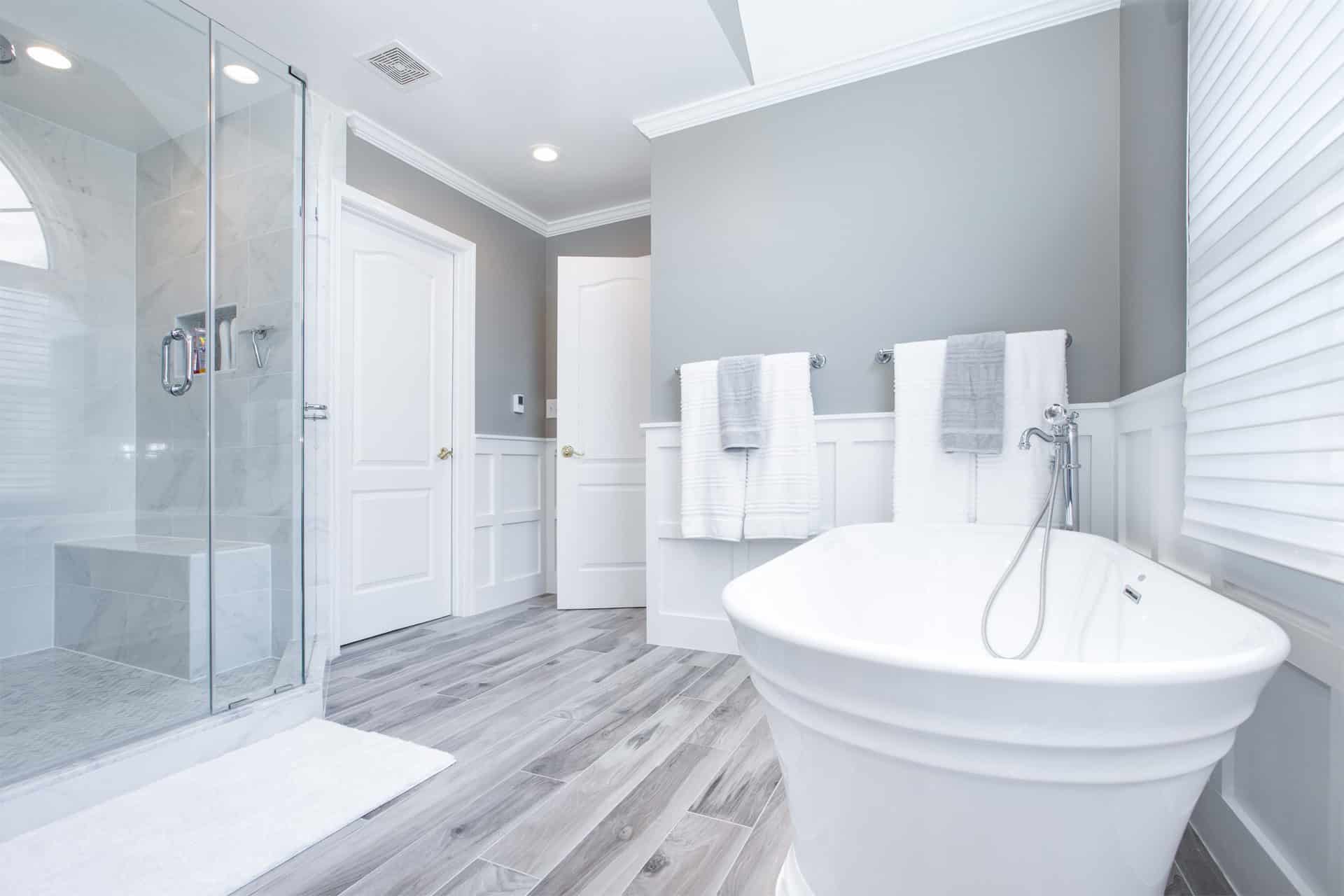
Primary-suite territory: layout changes, a curbless walk-in shower with body sprays and a linear drain, freestanding tub, double floating vanity, heated tile floors, custom niches and benches, designer lighting, and sometimes borrowing space from an adjacent closet or bedroom to enlarge the room. In Columbia’s higher-end pockets, River Hill, Clarksville borders, newer Maple Lawn construction, this tier is increasingly common, and it’s the subject of our separate guide on designer bathrooms in Columbia.
Bathroom Remodel Cost by Size
Bathroom size matters less than people expect, a small bathroom with elaborate tile can cost more than a large one with simple finishes, but it sets the baseline for materials and labor hours.
| Bathroom Type | Typical Size | Columbia Remodel Range (2026) |
|---|---|---|
| Powder room / half bath | 18–30 sq ft | $5,000 – $12,000 |
| Hall / guest full bath | 40–60 sq ft | $15,000 – $30,000 |
| Primary bathroom | 70–120 sq ft | $25,000 – $55,000 |
| Large primary suite bath | 120–200+ sq ft | $45,000 – $75,000+ |
Powder rooms deserve a note: they’re the cheapest room in the house to make dramatic. Because there’s no shower or tub, the budget goes to a statement vanity, bold wallpaper or tile, and good lighting, high impact for modest money.
Where the Money Goes: Cost Breakdown by Category
For a typical mid-range Columbia bathroom remodel, expect the budget to split roughly like this:
| Category | Share of Budget | Notes |
|---|---|---|
| Labor (all trades) | 40–50% | Demo, plumbing, electrical, tile, carpentry, finish |
| Tile & shower | 15–20% | The wet area is the most labor-intensive zone |
| Vanity & countertop | 10–15% | Stock to custom is a wide range |
| Fixtures & fittings | 8–12% | Toilet, faucets, shower valve & trim |
| Glass, mirrors, lighting | 5–10% | Frameless glass alone runs $1,200–$3,000 |
| Permits, dumpster, misc. | 3–5% | Howard County permit fees are modest |
Labor’s share is the number to internalize: in a bathroom, you’re paying primarily for skilled hands in a small space, a plumber, an electrician, a tile setter, and a carpenter all working sequentially in 50 square feet. This is also why contractor quality matters more in bathrooms than almost any other room: there is no such thing as a minor mistake inside a wall that holds water.
What’s Different About Remodeling a Bathroom in Columbia
The housing stock has a signature
Columbia’s villages were developed in sequence, Wilde Lake and Harper’s Choice in the late 1960s, Oakland Mills and Long Reach through the 1970s, Owen Brown, Kings Contrivance, Hickory Ridge and Dorsey’s Search into the 1980s, River Hill largely in the 1990s. Each wave has predictable bathroom quirks:
Late-1960s–70s homes (Wilde Lake, Harper’s Choice, Oakland Mills): original cast-iron tubs that are heavy to remove, galvanized or early copper supply lines worth evaluating during demo, mud-set tile floors that add demolition time, and bathrooms that are often genuinely small by modern standards, making layout creativity valuable.
1980s homes (Owen Brown, Kings Contrivance, Hickory Ridge): the golden age of the cultured-marble vanity top, honey-oak cabinetry, brass fixtures, and fiberglass tub surrounds. These bathrooms usually have sound bones and sensible layouts, ideal candidates for the mid-range full remodel, because the money goes to finishes rather than reconstruction.
1990s+ homes (River Hill, Dorsey’s Search infill): larger primary baths with garden tubs that owners now almost universally want replaced by walk-in showers. The garden-tub-to-shower conversion is arguably the defining Columbia primary-bath project of the 2020s: it reclaims a huge footprint for a spacious curbless or low-curb shower.
Condos and townhouses (Town Center and throughout the villages): remodels here add an association-approval step and care around shared plumbing stacks, but they’re routine for an experienced local crew.
CPRA and village covenants
Columbia’s residential covenants, administered through the Columbia Association and village architectural committees, mostly govern exterior changes, so an interior bathroom remodel typically doesn’t need village approval. Condo and HOA communities are the exception: buildings and townhome associations often require notice or approval for work involving plumbing. Your contractor should ask about this on day one, not discover it on demo day.
Howard County permits and inspections
Bathroom permits in Columbia go through the Howard County Department of Inspections, Licenses and Permits (DILP). The rule of thumb:
Permit required: moving or adding plumbing fixtures, new or relocated electrical circuits (including adding a GFCI circuit or an exhaust fan where none existed), structural changes, and tub-to-shower conversions that alter drain locations.
Usually no permit: like-for-like replacement, new vanity in the same location, new toilet on the existing flange, re-tiling, painting, swapping a faucet.
Inspections typically cover rough plumbing, rough electrical, and final. A remodeler who works Howard County weekly will fold the permit timeline into your schedule invisibly; GBC pulls county permits and meets the inspectors as part of every project that needs them.
How Long Does a Bathroom Remodel Take in Columbia?
Plan around two clocks: the lead-time clock and the construction clock.
Lead time (2–4 weeks, sometimes more): design decisions, vanity and tile ordering, glass templating (measured after tile is set, adding 1–2 weeks near the end for fabrication), and permit filing where required. Custom vanities and specialty tile can stretch this considerably, a good schedule doesn’t start demolition until the critical materials are physically in hand.
Construction:
| Project Type | On-Site Duration |
|---|---|
| Powder room refresh | 3–7 days |
| Cosmetic full-bath refresh | 1–2 weeks |
| Mid-range full remodel | 3–5 weeks |
| Tub-to-shower conversion | 3–5 weeks |
| Luxury gut / layout change | 6–8+ weeks |
The sequence rarely varies: demo → rough plumbing and electrical → inspection → backer board and waterproofing → tile → vanity, toilet and trim → glass → punch list. The waterproofing step is the one you should ask any prospective contractor to explain in detail, modern membrane systems (liquid-applied or sheet) behind the tile are what separate a 30-year shower from a 7-year one, and it’s precisely the step a cut-rate crew skips because it’s invisible on day one.
One Columbia-specific scheduling note: if your home has a single full bathroom, true of some smaller Wilde Lake and Oakland Mills floor plans, tell your contractor up front. Sequencing can keep a toilet functional for most of the project, and the crew can compress the un-usable window to days rather than weeks.
2026 Design Trends Columbia Homeowners Are Choosing
What we see selected in our Columbia showroom, project after project:
Walk-in showers over tubs, with one exception. The tub-to-shower conversion dominates, but keep at least one tub in the house if you may sell to a family with young children. The usual pattern: shower in the primary, tub preserved in the hall bath. Our guide to walk-in shower design ideas covers the layouts in depth.
Double vanities wherever the wall allows. Sixty inches is the comfortable minimum for two sinks; at 48–54 inches, a single sink with a long counter often works better than two cramped basins. More in our double vanity guide.
Quartz countertops have effectively replaced cultured marble and granite in bathroom vanities, non-porous, no sealing, and the veined marble-look patterns dominate. See the options in our countertops lineup.
Large-format porcelain tile (12x24 and up) on floors and shower walls: fewer grout lines, faster maintenance, visually calmer small rooms.
Warm, layered lighting, sconces flanking the mirror at face height instead of a single strip above (dramatically better for shaving and makeup), a dimmable overhead, and often a small waterproof fixture in the shower.
Heated floors in primary baths: at roughly $10–$20 per square foot installed during a remodel, electric radiant mats are one of the least expensive genuine luxuries in the house, a Maryland January argument that makes itself.
Comfort-height toilets, matte black and brushed-gold fixtures, and medicine cabinets that are actually attractive round out the standard 2026 selections. Bolder color is back too, deep green and navy vanities have overtaken all-white as the requested look, consistent with the broader 2025–26 bathroom trends.
Aging-in-place features are quietly becoming standard rather than special requests: curbless or low-curb showers, blocking in the walls for future grab bars (cheap during a remodel, disruptive later), handheld shower heads on slide bars, and better lighting. Columbia’s original generation of homeowners is aging in the homes they bought new, and smart remodels plan for the next 20 years.
Material Costs in Columbia (2026 Pricing)
Installed pricing for the selections that drive most bathroom budgets in the Howard County market:
| Material / Item | Typical Installed Cost (2026) | Notes |
|---|---|---|
| Porcelain floor tile | $12 – $25 / sq ft | Large-format at the upper end |
| Shower wall tile | $18 – $40 / sq ft | Niches, benches, patterns add labor |
| Natural stone / marble tile | $30 – $60+ / sq ft | Requires sealing; slower install |
| Quartz vanity top | $60 – $110 / sq ft | Most-selected top in 2026 |
| Stock vanity | $400 – $1,200 | Cabinet only |
| Semi-custom vanity | $1,200 – $3,500 | The mid-range sweet spot |
| Custom vanity | $3,500 – $8,000+ | Built to the wall, any finish |
| Frameless glass enclosure | $1,200 – $3,000 | Semi-frameless from ~$800 |
| Freestanding tub | $1,200 – $5,000+ | Plus filler faucet $500–$1,500 |
| Comfort-height toilet | $350 – $900 installed | Wall-hung units run higher |
| Electric heated floor | $10 – $20 / sq ft | Cheapest during a remodel |
| Exhaust fan (proper CFM, ducted) | $350 – $800 | Never optional in Maryland |
Two selection notes from the showroom floor. First, tile labor often exceeds tile material, an intricate herringbone accent wall costs more in setter hours than in tile, so simplifying the pattern (not the tile quality) is the efficient way to trim. Second, the vanity is the bathroom’s kitchen-cabinet moment: it’s the piece you touch every day, and stepping from stock to semi-custom typically buys better drawer boxes, soft-close hardware, and a size that actually fits the wall rather than leaving awkward filler gaps.
Hidden Costs Columbia Homeowners Should Expect
The difference between a smooth project and a stressful one is usually whether these were discussed before demo day:
Subfloor and joist repair ($500–$3,000). The most common surprise in Columbia’s older villages. Decades of minor splash leakage around a tub rots subfloor invisibly; it’s only confirmed once the tub is out. A fair contract prices this as a pre-agreed unit cost rather than an open-ended change order.
Plumbing stack and shut-off valve age ($300–$2,000). In late-1960s and 70s homes, demo can reveal supply lines and stops at end-of-life. Replacing them while the wall is open costs a fraction of doing it later through finished tile.
Electrical upgrades ($400–$1,500). Today’s code expectations, GFCI protection, a dedicated fan circuit, adequate lighting circuits, often exceed what a 1975 bathroom was built with. If a permit is pulled, the inspector will expect the wet-area electrical brought to current standards.
Ventilation ducting ($300–$900). Many original Columbia bathrooms have fans that vent into the attic instead of through the roof or soffit, a mold generator in Maryland’s humid summers. Correcting the duct run is money you’ll never see but will always benefit from.
Glass lead time (schedule, not money). Frameless glass is templated only after tile is complete and fabricated over 1–2 weeks. It’s the last major item in, and no one can compress it, a contractor who promises otherwise is guessing.
Common Bathroom Remodeling Mistakes to Avoid
Designing around a phone screen. Tile and quartz read differently under showroom lighting than on Instagram. Physical samples, viewed together, prevent the most common regret.
Skipping the exhaust fan upgrade. A beautiful new bathroom with the original underpowered fan will grow the same mildew as the old one. Size the fan to the room (roughly 1 CFM per square foot, more for high ceilings) and duct it outdoors.
Moving fixtures without a reason. Relocating a toilet or shower drain adds thousands in plumbing and flooring work. Sometimes it’s worth it, often the existing layout, refreshed, is 90% of the result for 70% of the cost. A designer should show you both versions before you decide.
Choosing the low bid without reading it. Bathroom bids diverge because scopes diverge. The $14,000 quote and the $24,000 quote for the “same” bathroom usually differ in waterproofing system, tile allowance, glass spec, and who actually performs the labor. Normalize the scopes before comparing numbers.
Postponing blocking and future-proofing. Plywood blocking behind the walls for future grab bars costs almost nothing during a remodel and makes the bathroom adaptable for decades. It’s the cheapest insurance in the entire project.
Is a Bathroom Remodel Worth It in Columbia? (ROI)
By the numbers, a mid-range bathroom remodel in the Baltimore–Washington region recoups roughly 60–70% of its cost at resale, per Remodeling Magazine’s Cost vs. Value data, and that understates the practical effect in Columbia specifically. When most comparable listings in your village share the same 1980s builder bathroom, an updated one is a genuine differentiator, and dated bathrooms are among the first things Howard County buyers flag in showings.
Two honest caveats. First, ROI percentages measure resale recovery, not the years of daily use before you sell, the real return on a bathroom you use twice a day is mostly lived, not sold. Second, over-improving is possible: a $75,000 spa bath in a village where homes trade at $450,000 won’t return proportionally. Match the remodel tier to the home’s value band, a rule of thumb is 5–10% of home value for a primary bath, and you’ll be on the right side of the math.
How to Choose a Bathroom Remodeling Contractor in Columbia
The bathroom is the highest-risk room in the house to remodel badly, water, electricity, and ventilation all inside 50 square feet. A vetting checklist that actually discriminates:
Maryland MHIC license and insurance. Ask for the Maryland Home Improvement Commission license number and certificate of insurance. Verify the license on the state’s site, it takes two minutes.
Who exactly does the work? The single most useful question. Many firms sell the job, then hand it to whichever crew is free. Ask: are the plumbers, electricians, and tile setters your employees? GBC’s answer is that every trade on a GBC project is in-house, your project is coordinated by a dedicated GBC project manager from design through the final walkthrough, which is also why we can put a 3-year workmanship warranty behind it rather than the industry-standard one year.
Waterproofing specifics. Ask what shower waterproofing system they use and why. A confident, specific answer (membrane brand, how they treat corners and niches, flood-testing practice) tells you more than any portfolio photo.
Local, recent, checkable references. Reviews tied to a physical local presence beat anonymous lead-site stars. GBC’s Columbia showroom holds a 5.0-star Google rating across 74 reviews, and you can read project-level detail in our testimonials.
A real showroom. Picking tile, quartz, and vanities from physical samples, under proper lighting, next to each other, prevents the most common regret in remodeling: materials that looked different on a phone screen. Our Columbia showroom at 9204 Berger Rd, Suite E exists for exactly this.
A written, itemized proposal with allowances spelled out, a payment schedule tied to milestones (never a large majority up front), and the permit responsibility named in the contract.
Credentials that require ongoing scrutiny. NARI membership and sustained recognition, GBC has earned Houzz and Angi awards each year from 2023 through 2025, indicate a company that performs consistently, not occasionally.
Budgeting and Financing Your Columbia Bathroom Remodel
Practical budgeting sequence: get a real quote before setting the budget (not the other way around), then add a 10–15% contingency, smaller than a kitchen’s, since bathroom surprises are more contained, but real, because tubs hide subfloor damage and 1970s walls hide plumbing surprises. If the numbers stretch, cut scope rather than quality in wet areas: a smaller-but-perfectly-waterproofed shower beats a bigger one built on shortcuts, and vanity hardware can be upgraded later, tile work can’t.
Where saving is smart: keep the layout, use large-format porcelain instead of natural stone, choose a quality stock or semi-custom vanity over full custom, and limit statement tile to one accent zone. Where saving is false economy: waterproofing, shower valves, ventilation, and labor.
GBC also offers financing options that let Columbia homeowners spread project costs rather than deferring the remodel another year, details and current terms are on the financing page or available at the showroom.
Why Columbia Homeowners Choose GBC Kitchen & Bath
GBC Kitchen & Bath has been remodeling bathrooms and kitchens in the DMV since 2001, with four showrooms across the region, and the Columbia location at 9204 Berger Rd, Suite E puts a full design center ten minutes from every village in the city. What sets the projects apart:
Experienced, insured installers. One accountable team from design through punch list.
A 3-year workmanship warranty, three times the industry-standard coverage, because we’re still here, locally, if anything needs attention.
A 5.0-star Google rating at the Columbia showroom (74 reviews), plus Houzz and Angi recognition every year from 2023 to 2025 and NARI membership.
Design-build under one roof: you select real materials in the showroom, the designer who plans your bathroom coordinates the crew that builds it, and GBC pulls the Howard County permits and meets the inspectors.
We serve all of Columbia, Wilde Lake, Harper’s Choice, Oakland Mills, Long Reach, Owen Brown, Kings Contrivance, Hickory Ridge, Dorsey’s Search, River Hill, Town Center, plus Ellicott City, Clarksville, Fulton, Elkridge, Laurel, Jessup, and Maple Lawn. If a kitchen is also on your list, see our dedicated page on kitchen remodeling in Columbia, or explore the full bathroom remodeling service overview.
Ready to start? Visit the Columbia showroom, call (410) 417-6060, or book a free design consultation, we’ll walk your bathroom, talk through options honestly, and give you a real number.
