**Key Takeaway, ** A full basement finish in Columbia, MD costs $40,000–$70,000 for a mid-range project in 2026, about $50–$90 per square foot, with refreshes from $25,000 and high-end builds with a bathroom, wet bar, and theater reaching $110,000+. Howard County requires a permit, bedrooms need a code-compliant egress window, and moisture must be resolved before framing. GBC Kitchen & Bath finishes basements across all of Columbia from its 5.0-star Berger Road showroom.
The cheapest square footage you will ever add to a Columbia home is already under it. While an addition costs several hundred dollars per square foot, finishing the basement delivers livable space at $50–$90, and Columbia’s housing stock is unusually rich in candidates. The village-built homes of the 1970s–90s came with generous unfinished basements or, nearly as common, basements “finished” decades ago with wood paneling, drop ceilings, and carpet that has outlived three sofas.
This guide covers what Columbia homeowners need to plan a basement remodel in 2026: real local costs by scope, what Howard County requires (permits, egress, ceiling heights), the moisture-first rule that separates lasting finishes from moldy regrets, what your village’s construction era means for the project, in-law suites and accessory apartments, timelines, hidden costs, and how to choose a contractor who finishes basements properly.
Basement Remodeling Cost in Columbia at a Glance (2026)
The fast answer first. Columbia tracks the wider Baltimore–Washington market:
| Project Scope | Columbia Cost (2026) | Typical For |
|---|---|---|
| Refresh of finished basement | $25,000 – $45,000 | New flooring, lighting, paint, updated bath |
| Mid-range full finish | $40,000 – $70,000 | Framing to finished rec room + storage |
| Full finish + bathroom | $55,000 – $90,000 | The most common complete project |
| High-end build-out | $75,000 – $110,000+ | Bath + wet bar + theater/gym + suite |
Rule-of-thumb pricing runs $50–$90 per square foot depending on finishes and how much infrastructure (bathroom, wet bar, egress) the plan includes. The four big cost levers: whether you add a bathroom ($15,000–$25,000), whether an egress window must be cut ($4,000–$8,000), how much moisture and drainage work the space needs first, and the ceiling treatment low-hanging ducts demand.
What Your Village’s Era Means for the Project
Columbia’s basements were built in waves, and each wave sets different starting conditions:
Late-1960s–70s villages (Wilde Lake, Harper’s Choice, Oakland Mills, Long Reach). Block foundation walls, ceilings on the lower side, and mechanicals placed with 1970 logic. Many of these basements got the wood-paneling treatment in the 80s, demolition of the old finish is part of the scope, and it’s the right call: behind fifty-year-old paneling we routinely find insulation-free walls and the occasional slow leak that explains a musty smell someone lived with for a decade. Plan around soffits, and treat the low-ceiling zones as design features, storage walls, media built-ins, rather than fighting them.
1980s villages (Owen Brown, Kings Contrivance, Hickory Ridge, Dorsey’s Search). Better ceiling heights, poured or block walls in good order, and floor plans that finish beautifully. The typical project here is the classic full finish: big rec room, guest room with egress, full bath, storage zone. These are the smoothest basement projects in Columbia.
1990s+ (River Hill and newer infill). Poured foundations, 8–9 foot ceilings, and, the gift that keeps giving, bathroom rough-ins already stubbed into the slab on many homes. If you see a capped drain trio in your unfinished floor, your future bathroom just got $5,000–$10,000 cheaper. These basements support the most ambitious programs: theaters, wet bars, gyms, full in-law suites.
Moisture First: The Non-Negotiable Rule
Maryland sits on clay-heavy soils and swings through humid summers, which means every Columbia basement project starts with a moisture evaluation, not a design meeting. The checklist:
Outside first: grading that slopes away from the foundation, downspouts discharging well clear of the walls, window wells that drain. Half of “basement water problems” are actually roof-water problems, and the fix costs hundreds, not thousands.
Inside second: evidence of efflorescence or staining on the walls, the sump pump’s age and behavior (and whether it has a battery backup, worth every dollar in a summer storm), slab cracks, and humidity readings.
Then the assembly: modern basement finishes use moisture-tolerant materials as standard, rigid foam or rockwool insulation against foundation walls instead of fiberglass-in-plastic, PVC-free luxury vinyl plank over the slab instead of solid hardwood, mold-resistant drywall in the right zones, and a properly sized dehumidification plan.
If real drainage work is needed, interior French drain, new sump basin, it typically runs $3,000–$10,000 and belongs in the budget before a dollar goes to finishes. Framing over an unsolved water problem is the single most expensive mistake in basement remodeling; we won’t do it, and neither should anyone you hire.
Howard County Rules: Permits, Egress, Ceilings
Finishing a basement in Columbia is permit work, framing, electrical, insulation, and usually plumbing all get inspected by the Howard County Department of Inspections, Licenses and Permits (DILP). The three code items that shape design:
Egress. Any basement bedroom requires a code-compliant emergency escape, an egress window with a properly sized well, or a walkout door. Cutting a new egress window into a foundation wall runs $4,000–$8,000 including the well and drainage. Even where not strictly required, an egress window transforms a basement’s light and its resale story.
Ceiling height. Habitable rooms must meet minimum ceiling heights (with allowances for beams and soffits). This is rarely a problem in 1980s+ homes and occasionally a design constraint in the earliest villages, an experienced designer plans the room layout around the ductwork rather than discovering it at inspection.
Smoke/CO and electrical. Finishing triggers current-code requirements: interconnected smoke and CO detectors, AFCI protection, proper outlet spacing. If your panel is already crowded, budget for a subpanel ($800–$1,500).
One more Columbia-specific layer: if your long-term plan is a separately rentable accessory apartment rather than a family in-law suite, Howard County has its own approval process and requirements, and village covenants may add conditions. Declare that intent on day one; it changes egress, layout, and paperwork. GBC handles the DILP permits and inspection scheduling on every project either way.
What Columbia Homeowners Build Downstairs
The finished square footage is a blank slate, and the program mix we build most often:
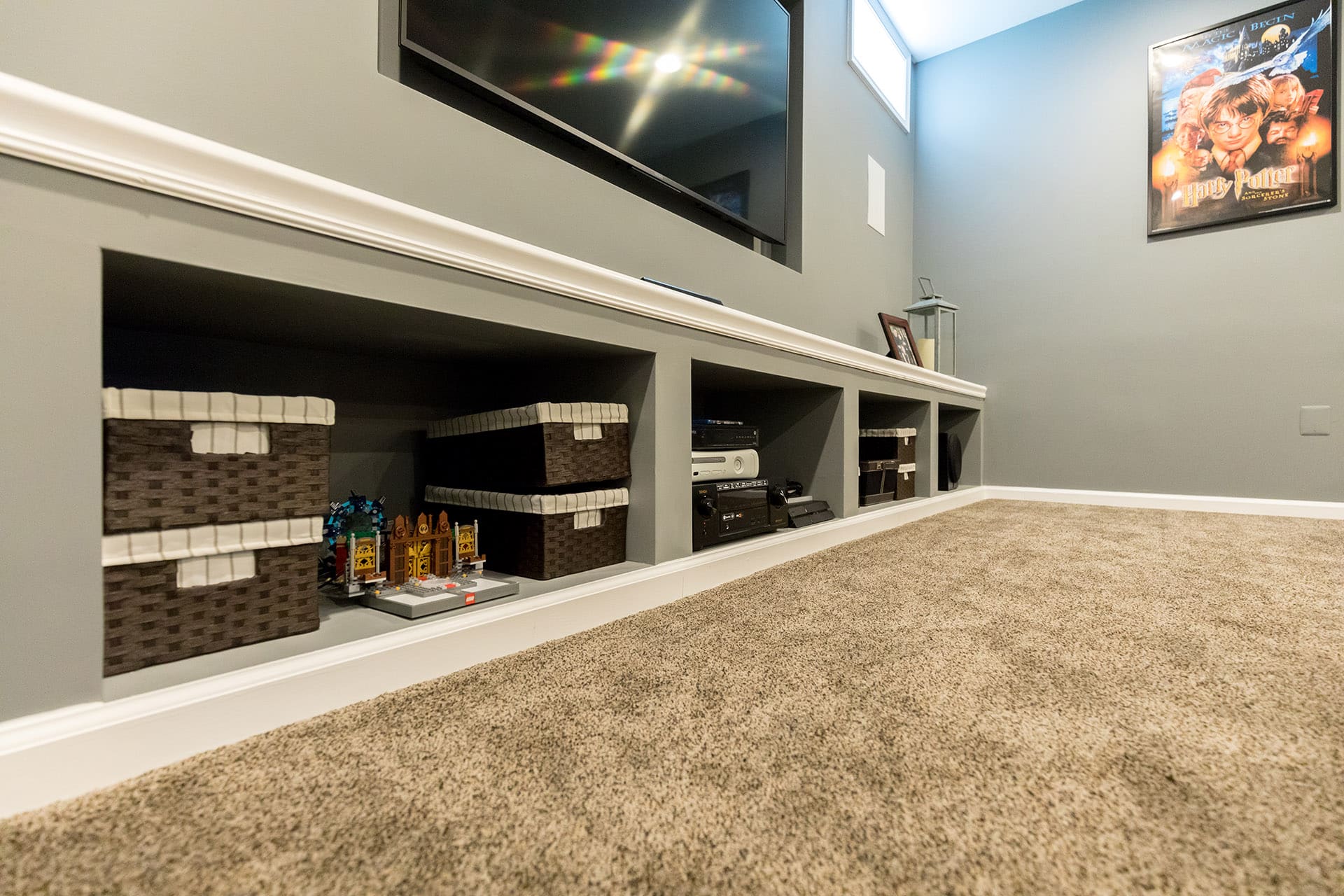
The all-purpose family level, big rec room, TV wall with built-ins, play zone, storage room. The workhorse. Our basement finishing ideas guide catalogs the layouts.
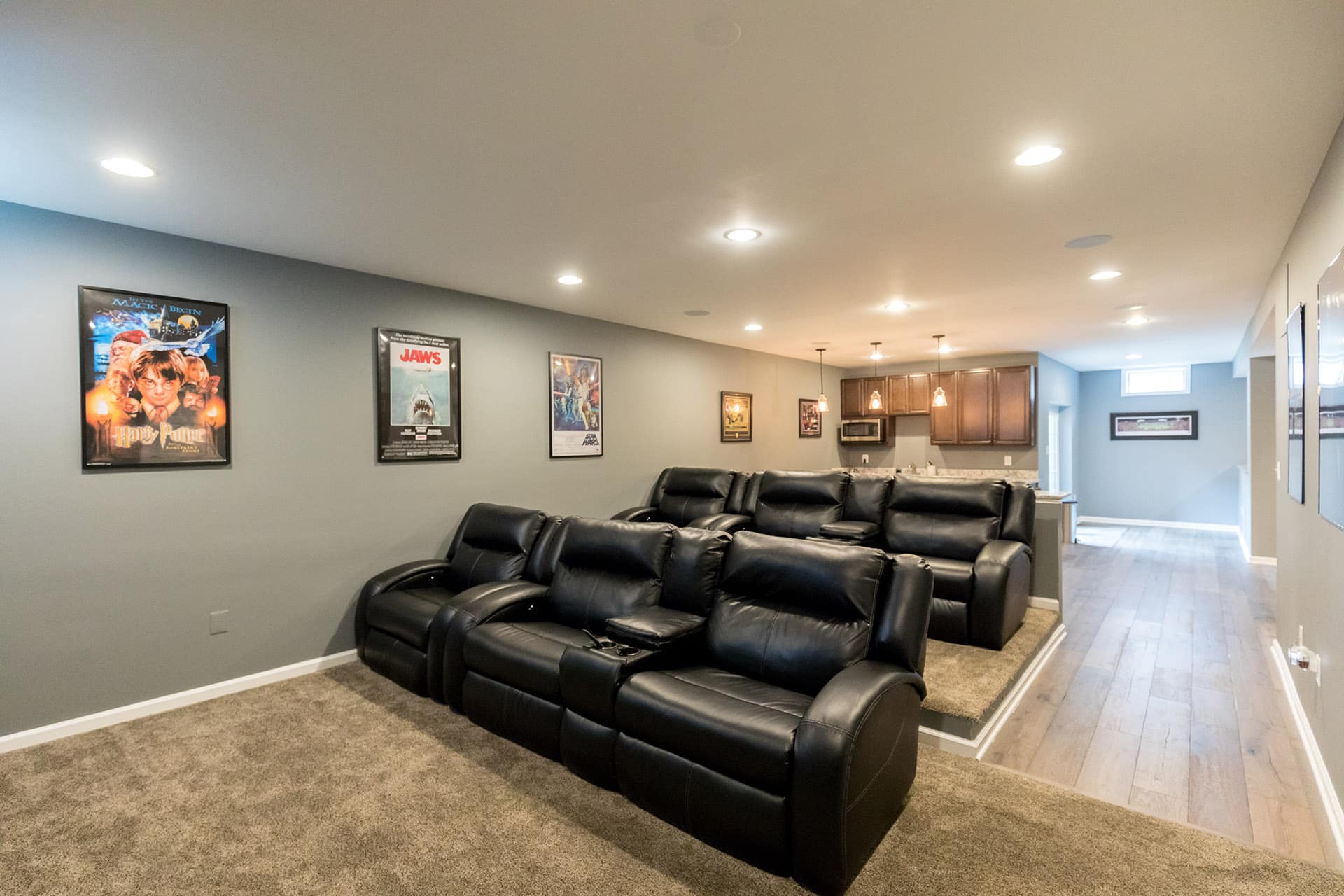
The home theater, riser platform, blackout-friendly lighting, speaker pre-wire, snack counter behind the seats. Columbia’s 1990s basements were made for it; see the basement home theater guide.
The home office, with two working adults per household the norm and half of Howard County commuting to laptops, a proper below-grade office with real lighting, sound isolation, and a door that closes is the quiet star of 2026 requests. Details in the basement home office guide.
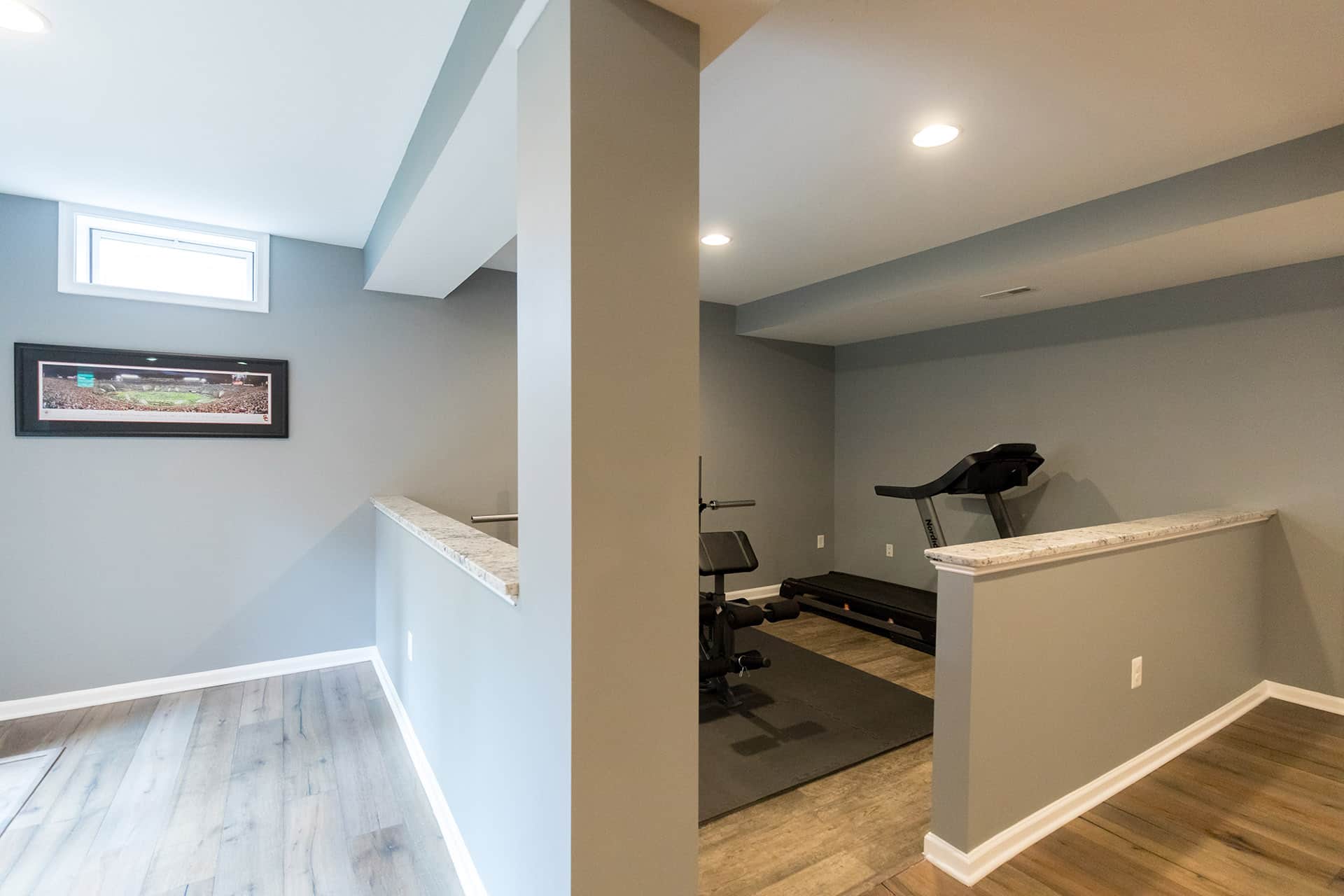
The gym, rubber flooring, mirrors, a mounted TV, and ventilation done right (a gym without airflow planning becomes a humidity problem you built on purpose).
The guest / in-law suite, bedroom with egress, full bath, sometimes a kitchenette. With aging parents joining households across the region, this is Columbia’s fastest-growing basement program; the basement guest suite guide covers layouts, and pairing it with our bathroom expertise is where a kitchen-and-bath design-build firm earns its keep below grade.
The wet bar / entertaining zone, from a beverage-fridge counter ($8,000–$12,000) to a full second kitchen ($20,000+), usually paired with the game room program.
Where the Money Goes
For a typical mid-range Columbia full finish:
| Category | Share of Budget | Notes |
|---|---|---|
| Framing, drywall, ceilings | 20–25% | Soffits and access panels included |
| Electrical & lighting | 12–18% | Recessed LED, circuits, code items |
| Bathroom (if added) | 20–30% | The biggest single swing item |
| Flooring | 8–12% | LVP dominates below grade |
| Insulation & moisture assembly | 8–12% | The part you never see and always feel |
| HVAC extension | 5–8% | Supply/return runs into new rooms |
| Permits, egress, misc. | 5–10% | Egress window if required |
Labor realities: basements are sequencing-heavy, framing, electrical, plumbing, HVAC, insulation, drywall, flooring, and trim all pass through in order, with county inspections between. That’s why the in-house-crew question matters more here than almost anywhere: a schedule with five separate trades and three inspections is where multi-contractor projects go to stall.
How Long Does a Basement Remodel Take in Columbia?
Design + permit + lead time: 3–6 weeks. Layout decisions, selections, DILP permit review, and material ordering.
Construction:
| Project Type | On-Site Duration |
|---|---|
| Refresh (flooring, paint, lighting) | 3–4 weeks |
| Mid-range full finish | 6–8 weeks |
| Full finish + bathroom | 8–10 weeks |
| High-end build-out (bath + bar + theater) | 10–14 weeks |
The rhythm: moisture work → framing → rough electrical/plumbing/HVAC → county rough inspections → insulation → drywall → paint → flooring → trim, doors, built-ins → fixtures → final inspection. Because the work zone is downstairs and self-contained, basement projects intrude on family life far less than a kitchen, a dust-sealed stairwell door and a crew that treats the main floor as off-limits keep it that way.
Hidden Costs Columbia Homeowners Should Expect
Sewage ejector pump ($2,000–$4,000). If the new bathroom’s drains sit below the sewer line, common, an ejector basin handles it. (River Hill-era rough-ins often already solved this.)
Radon check and mitigation ($200 test / $1,200–$2,000 system). Howard County sits in a high-radon zone. Test before finishing; a mitigation system is simple to add before drywall and annoying after.
Duct rerouting and soffit surprises ($500–$3,000). The main trunk line runs where it runs. Good design absorbs it; discovering it mid-framing costs change orders.
Old-finish demolition ($1,500–$4,000). Peeling back the 1980s paneling, drop ceiling, and glued-down carpet, and disposing of it, is real scope in the older villages. Pre-1980 flooring can warrant an asbestos check before disturbance.
Subpanel or circuit capacity ($800–$1,500). A theater, gym, bar fridge, and baseboard of recessed lights add up; crowded panels need a subpanel.
Sump battery backup ($600–$1,200). The best insurance in the house: the storm that floods basements is the same one that cuts power.
Design Details That Make a Basement Not Feel Like One
The difference between “finished basement” and “favorite floor of the house” is a handful of decisions that cost little when made early:
Light it like it has windows. Below grade, lighting is the architecture: denser recessed layout than upstairs (roughly one can per 25–30 square feet), warm 2700–3000K color temperature, dimmers everywhere, and a few wall-washing fixtures that push light onto vertical surfaces, the trick that makes a room read bright rather than lit.
Choose ceilings strategically. Drywall ceilings look best and cost least headroom; modern two-inch-profile drop ceilings preserve access to plumbing and dampers and look nothing like an office anymore. The right answer is often both: drywall in the main rooms, access-friendly panels in the utility runs. Either way: access panels at every shutoff and cleanout, the $40 detail that saves a $400 drywall repair.
Continue the house down the stairs. Refinishing the basement stairs and landing, same flooring family, proper lighting, real handrail, makes the new level feel like part of the home instead of an annex behind a door.
Warm materials, deliberate color. Below grade, cool gray reads cold. The palettes that work in Columbia’s basements leans warm, creamy walls, wood-look LVP, textiles with weight, and treats the TV wall or bar as the one deliberate statement.
Soundproofing: The Upgrade Everyone Wishes They’d Bought
A basement’s superpower is acoustic separation, if you build it in. The high-value package: rockwool insulation in the ceiling joists under bedrooms and living areas, solid-core doors on the theater and office, and for serious media rooms, resilient channel or sound-isolation clips under the ceiling drywall. Add a wrapped duct silencer where the trunk line passes the theater and the movie stays downstairs while the kids sleep upstairs. Done during construction this package costs a fraction of any retrofit, and it’s precisely what turns the home office and theater programs from good to genuinely private.
Common Basement Remodeling Mistakes to Avoid
Finishing before fixing the water. The headline mistake, worth repeating: no framing until the moisture story is solved and verified through a wet season if the history is doubtful.
One-bulb-per-room lighting. The surest tell of a budget flip. Lighting is the least expensive transformative line in the whole project, this is the wrong place to save.
Losing all the storage. An unfinished basement stores a household’s entire history; finish 100% of it and the garage pays the price. Great plans reserve a real storage room with utility access, usually 10–15% of the footprint.
Undersizing HVAC. New rooms need supply and return air. A basement that’s stuffy in July and cold in January is an HVAC-extension line item that got value-engineered out.
Cheap flooring straight over the slab. Glue-down carpet on damp concrete grows what you’d expect. Below grade, the assembly matters as much as the surface, vapor-aware underlayment, then LVP or carpet tile designed for it.
Forgetting the future bathroom. Even if the budget defers the bath, rough in the plumbing while the floor is open. It’s the cheapest optionality you’ll ever buy.
Is a Basement Remodel Worth It in Columbia? (ROI)
Finished basements recoup roughly 60–70% at resale in the Baltimore–Washington market per Cost vs. Value data, but the raw percentage understates the Columbia case in three ways. First, you’re adding usable square footage at a fraction of addition costs, and appraisers and buyers both count it. Second, in a market where most competing listings share the same unfinished or 1980s-paneled basement, a professionally finished lower level differentiates the whole house. Third, the in-law-suite configuration adds functional value no percentage captures, multigenerational flexibility that increasingly decides which house a family buys.
And as with every remodel: the return you live in, the playroom during the toddler years, the office during the career, the suite when parents arrive, is collected daily, long before any sale.
Choosing a Basement Contractor in Columbia
The basement-specific vetting questions, beyond the standard MHIC license and insurance checks:
“What’s your moisture protocol?” The right answer starts outside (grading, gutters), names the assembly (foam against foundation walls, LVP over slab, mold-resistant board), and refuses to finish over an active problem. A contractor who goes straight to paint colors hasn’t been burned yet, or has, and didn’t pay for it.
“Who does the work?” Basements run every trade in sequence; coordination is the product. GBC’s answer: experienced, insured installers across every trade, one crew, one schedule, one standard, and a 3-year workmanship warranty, triple the industry norm, behind all of it.
“Walk me through egress and permits.” Fluency with DILP, egress specs, and ceiling-height rules should be immediate. GBC pulls the Howard County permits and meets every inspector.
“Show me local proof.” Our Columbia showroom at 9204 Berger Rd, Suite E holds a 5.0-star Google rating across 74 reviews, backed by Houzz and Angi awards every year from 2023 through 2025, NARI membership, and a DMV track record since 2001, with the project-level detail on our testimonials page.
Budgeting and Financing
Sequence the money like the project: moisture and infrastructure first, finishes second, furniture last. Carry a 10–15% contingency (more if the basement has never been opened up). If the budget tightens, protect the invisible layers, drainage, insulation, electrical, and simplify finishes; you can upgrade carpet in five years, but you can’t re-insulate a finished wall without undoing the finish.
Basement projects are also where financing options shine: the space often starts earning its keep immediately, as an office that replaces a rented desk, a suite that replaces assisted-living gap years, or simply the family room that makes the house feel twice as big.
Why Columbia Homeowners Choose GBC Kitchen & Bath
GBC Kitchen & Bath has served the DMV since 2001 with four showrooms, and the Columbia design center on Berger Road puts real materials, flooring, cabinetry for wet bars and built-ins, tile and vanities for basement baths, ten minutes from every village. Experienced, insured installers. A 3-year workmanship warranty. A 5.0-star Google rating (74 reviews) at the Columbia location. And because basements so often contain a bathroom and a kitchenette, a kitchen-and-bath design-build firm brings exactly the two hardest trades to the easiest floor.
We finish basements across all of Columbia, Wilde Lake, Harper’s Choice, Oakland Mills, Long Reach, Owen Brown, Kings Contrivance, Hickory Ridge, Dorsey’s Search, River Hill, Town Center, plus Ellicott City, Clarksville, Fulton, Elkridge, Jessup, and greater Howard County. If the upstairs is also on your list, our Columbia kitchen and Columbia bathroom pages carry those details.
You can find our basement remodeling Columbia team on Google Maps, read the 74 Google reviews, browse real project photos, and get one-tap directions to the Berger Road showroom.
Ready to start? Visit the Columbia showroom, call (410) 417-6060, or book a free design consultation, we’ll walk the space, check the moisture story first, and give you a real number for the basement your house has been hiding.
