Granite still sells a lot of countertops. In a survey of 8,100 Angi customers, 44.6% said they preferred granite and 29.3% preferred quartz. So the two questions homeowners keep asking are fair ones: how much do granite countertops cost, and is granite or quartz the better buy? This guide answers both. Every price comes from a named, linked source, and every kitchen estimate shows its math so you can rerun it with your own measurements.
A quick note on how to read the numbers. They are typical national market ranges published by cost-research sites and the stone industry. They are not GBC Kitchen & Bath prices. Your real number depends on the slab you choose, how many square feet you need, the edge profile, the cutouts and the condition of your cabinets. The only way to get it is a measured, itemized quote.
Granite countertop cost at a glance
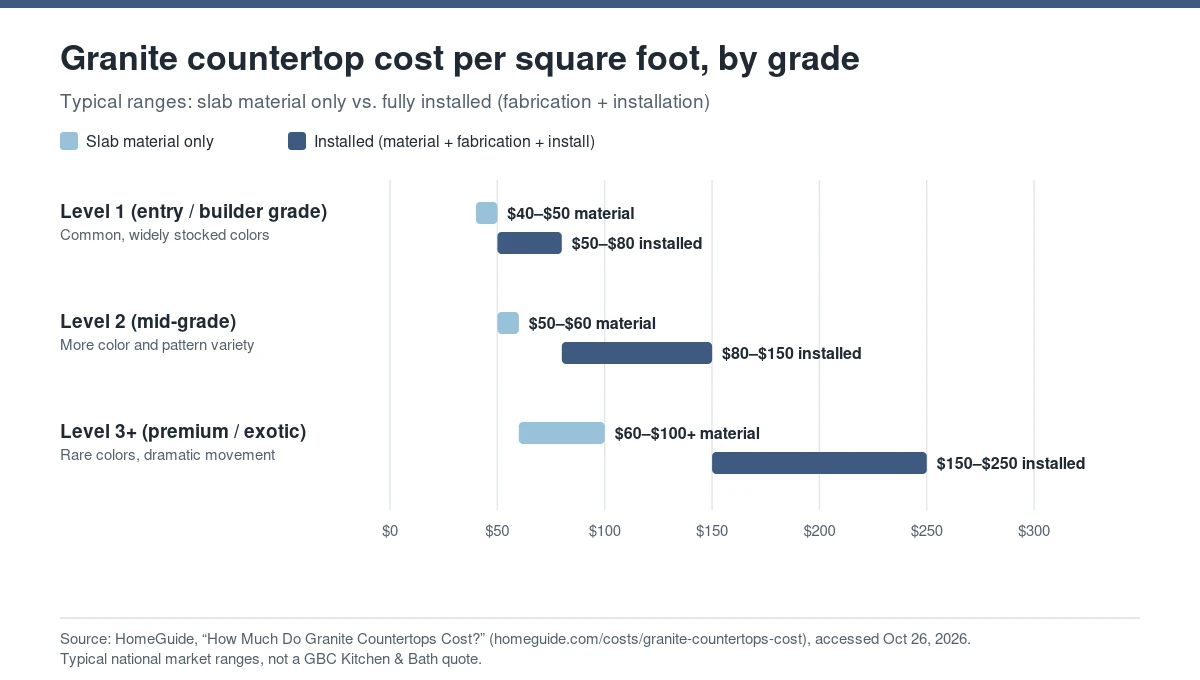
The short answer: most installed granite falls between $80 and $150 per square foot, according to HomeGuide’s granite cost guide. Entry-level slabs can come in near $50 per square foot installed, and rare or exotic stone can go past $250. For a typical 30 to 40 square feet of countertop, HomeGuide puts the total at about $2,400 to $6,000.
Angi’s 2026 granite cost guide uses a different method and lands in the same neighborhood. It reports that most granite countertop projects cost $2,000 to $4,000, with an average around $3,250. Large or high-end jobs can pass $9,000.
| Measure | Typical range | Source |
|---|---|---|
| Installed cost per sq ft (most projects) | $80–$150 | HomeGuide |
| Installed cost per sq ft (full range) | $50 to $250+ | HomeGuide |
| Slab material only, per sq ft | $40–$60, up to $100 for rare stone | Angi |
| Fabrication and installation labor, per sq ft | About $35 average (Angi); $10–$50 (HomeGuide) | Angi, HomeGuide |
| Typical total project | $2,000–$4,000; average about $3,250 | Angi |
| Total for 30–40 sq ft | $2,400–$6,000 | HomeGuide |
Why do the figures differ? Each company surveys different projects and contractors, and some quote material only while others include fabrication. The ranges overlap more than they conflict. When a quote you receive falls far outside all of them, ask the fabricator to explain what’s driving the price.
Granite price per square foot by grade
Stone yards and fabricators usually sort granite into price “levels” or “grades.” The labels are commercial, not geological. There is no industry-wide standard, so one supplier’s Level 2 may be another’s Level 3. In general, a higher level means rarer color, more movement or a more distant quarry, not a stronger or more durable stone.
| Grade | What it usually means | Slab material only | Installed |
|---|---|---|---|
| Level 1 (entry / builder grade) | Common, widely stocked colors with modest variation | $40–$50 per sq ft | $50–$80 per sq ft |
| Level 2 (mid-grade) | Wider choice of colors and patterns | $50–$60 per sq ft | $80–$150 per sq ft |
| Level 3 and up (premium / exotic) | Rare colors, dramatic veining, limited supply | $60–$100+ per sq ft | $150–$250 per sq ft |
Source: HomeGuide. Typical market ranges, not a GBC quote.
Imported stone is a big part of the price story. Most granite used in the U.S. is imported. The U.S. Geological Survey’s 2026 Mineral Commodity Summary for dimension stone puts the country’s net import reliance for granite at 85%. Granite imports were worth about $670 million in 2025. From 2021 to 2024, Brazil supplied 41% of that import value, India 25%, China 17% and Italy 6%. Freight, exchange rates and trade policy can all move slab prices. That is one reason a quote is usually valid only for a limited time.
What popular granite colors cost
Angi lists typical material prices for well-known granite varieties. Treat them as rough guides. Price depends on the specific slab lot, its thickness and where you buy it.
| Variety | Typical material cost per sq ft |
|---|---|
| Alaska White | About $35 |
| Ubatuba | $30–$60 |
| Absolute Black | $45–$60 |
| Black Galaxy | $50–$70 |
| Blue Louise | $70–$100 |
Source: Angi. Material only; excludes fabrication and installation.
How much granite costs for your kitchen size
Square footage drives cost more than anything else, so start there. Here is how to measure, then what 30, 40, 50 and 60 square feet typically cost.
How to measure your countertops
Measure each run of countertop in inches: length along the wall times depth. Standard base-cabinet countertops are usually about 25 inches deep, a figure HomeGuide gives as 25 or 25 5/16 inches. Add about 1.5 inches at any exposed end for the overhang. Measure islands and peninsulas separately, including any seating overhang. Multiply length by depth for each piece, add the pieces together, and divide by 144 to convert square inches to square feet.
Example: A 15-foot (180-inch) run of base cabinets at 24 inches deep is 4,320 square inches, or 30 square feet. Angi uses that 24 × 180 inch size as its “average kitchen” example and puts it at about $1,900 to $3,300.
Installed cost for 30, 40, 50 and 60 square feet
The table below runs two published rate sets against four common countertop areas. Method A adds Angi’s slab price ($40–$60 per square foot) to Angi’s average labor rate ($35 per square foot), for $75–$95 per square foot. Method B uses HomeGuide’s typical installed range of $80–$150 per square foot. Neither includes tear-out, upgraded edges, cutouts, backsplash or plumbing; those come in the next section.
| Countertop area | Typical kitchen | Method A: $75–$95/sq ft | Method B: $80–$150/sq ft | Entry to exotic: $50–$250/sq ft |
|---|---|---|---|---|
| 30 sq ft | Small kitchen or one long run | $2,250–$2,850 | $2,400–$4,500 | $1,500–$7,500 |
| 40 sq ft | Average kitchen | $3,000–$3,800 | $3,200–$6,000 | $2,000–$10,000 |
| 50 sq ft | Larger L-shape or U-shape | $3,750–$4,750 | $4,000–$7,500 | $2,500–$12,500 |
| 60 sq ft | Large kitchen with an island | $4,500–$5,700 | $4,800–$9,000 | $3,000–$15,000 |
Math: countertop area × published per-sq-ft rate. Rates from Angi and HomeGuide. Illustrative only; not a quote.
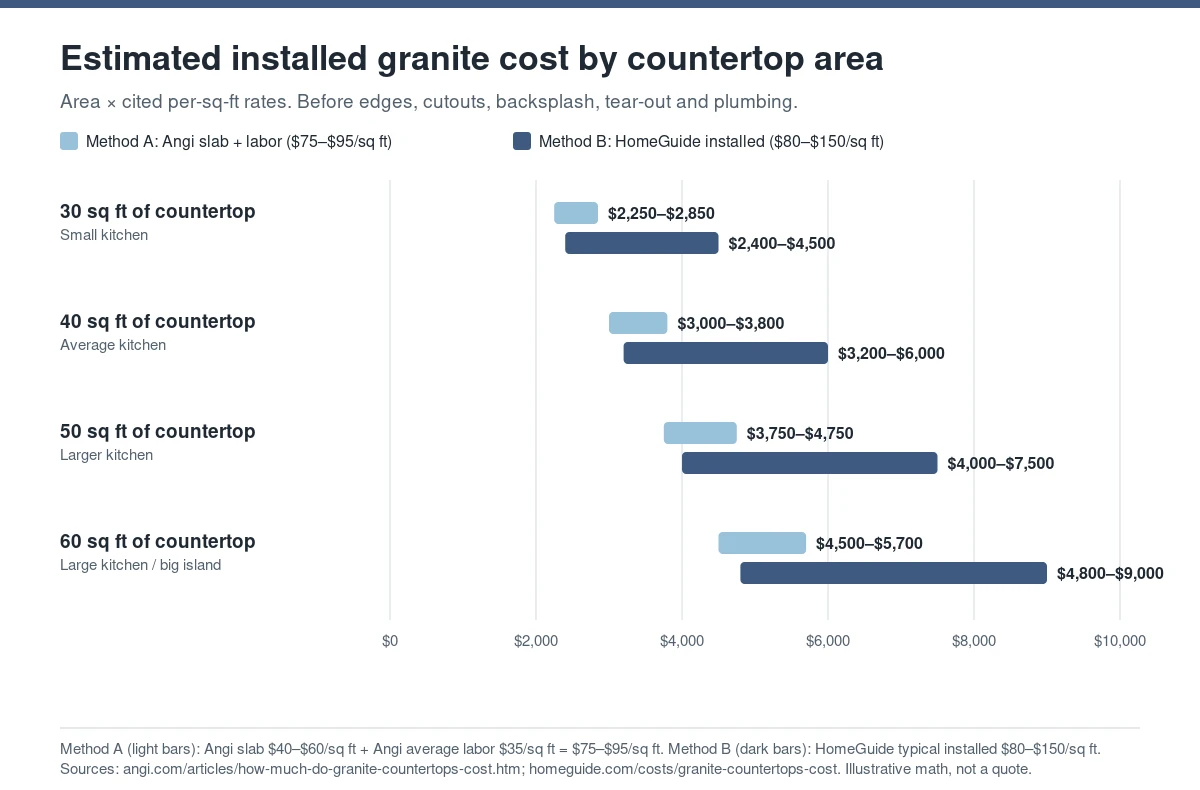
These results line up with HomeGuide’s own size tiers: about $1,600–$4,500 for a small kitchen of 20–30 square feet, $2,400–$6,000 for an average kitchen of 30–40 square feet, and $3,200–$9,000 or more for a large kitchen of 40–60+ square feet.
Cost by countertop piece
If you’re replacing just one section, or adding an island, Angi’s dimension-based examples are helpful:
| Piece | Example size | Typical cost |
|---|---|---|
| Average kitchen run | 24 × 180 in | $1,900–$3,300 |
| Short run | 24 × 72 in | $750–$1,400 |
| Kitchen island | 36 × 78 in | $1,000–$2,100 |
| Square island or table | 40 × 40 in | $650–$1,200 |
| Bar top | 16 × 36 in | $300–$600 |
Source: Angi.
Slab size and waste
Granite is sold by the slab, not by the exact square foot you install. HomeGuide notes that slabs commonly run about 6 to 10 feet long and 5 to 6 feet wide, roughly 30 to 60 square feet each. If your layout needs a piece just longer than one slab, or if you want the veining to flow continuously across an island, you may pay for more stone than ends up in your kitchen. Ask whether a quote is priced by the slab or by finished square foot, and who keeps the remnants.
What else affects granite countertop cost
The base square-foot price is only part of the bill. These line items often explain why two quotes for the “same” granite differ by thousands of dollars.
| Item | HomeGuide range | Angi range |
|---|---|---|
| Old countertop removal and disposal | $7–$14 per sq ft | $4–$7 per sq ft |
| Slab delivery | $150–$200+ per slab | $150–$200 |
| Undermount sink cutout | $100–$300 | About $100 |
| Cooktop cutout | $120–$400 | About $200 |
| Faucet or outlet cutout | $20–$60 each | Not listed |
| Upgraded edge profile | $0–$46 per linear ft by profile | $10–$40 per linear ft |
| Backsplash (4–6 in high) | $10–$34 per sq ft | Not listed |
| Honed finish | Not listed | +$10–$20 per sq ft |
| Leathered finish | Not listed | +$15–$25 per sq ft |
| Sealing | $200–$350 per treatment | $100+ |
| Plumbing changes | Not listed | $350–$2,000 |
Edge profiles
Edges are priced per linear foot of exposed edge, so a big island with seating on three sides adds up fast. A simple eased edge is often included. Ornate profiles take more machine and hand time.
| Edge profile | Typical added cost |
|---|---|
| Straight / flat | $0–$5 per linear ft |
| Eased | $0–$12 per linear ft |
| Bevel | $8–$16 per linear ft |
| Double bevel | $36–$40 per linear ft |
| Half bullnose | $12–$22 per linear ft |
| Ogee | $15–$25 per linear ft |
| Full bullnose | $15–$46 per linear ft |
| Rounded corners | $50–$140 each |
| Waterfall (stone running down the side of an island) | $40–$100+ per sq ft |
Source: HomeGuide.
2 cm vs. 3 cm thickness
Granite and quartz countertops are generally made in two thicknesses: 2 cm (about 3/4 inch) and 3 cm (about 1 1/4 inch). Cambria, for example, makes 2 cm and 3 cm slabs for countertops and 1 cm for vertical surfaces. Thickness affects more than price:
- Support. HomeGuide notes that stone thinner than 3 cm generally needs a plywood subtop. Overhangs beyond about 6 inches may need brackets or braces.
- Cabinets. Stone is heavy and unforgiving. Cambria’s care guidance calls for level cabinets, and HomeGuide notes that installers may need to shim cabinets level, which is common in older homes with uneven floors. Some cabinets also need support brackets for heavy slabs or long overhangs.
Seams
Seams are a fact of life with slab stone. HomeGuide notes that most average-sized kitchens need more than one slab, and L- or U-shaped layouts must be joined at corners. Seams are visible on both natural and engineered stone; Cambria says so plainly in its product care guide. With granite, each slab is unique. Consumer Reports notes that this can make it harder for installers to cut the pieces and line up multiple slabs for a seamless look. Ask to see a seam layout on a drawing or digital template before fabrication, especially on a busy, veined stone.
Removal, sink and plumbing work
Tear-out costs $4–$14 per square foot across the two sources above, and HomeGuide notes that most homeowners spend about $100–$250+ on removal; some companies include it in the replacement estimate. If you’re switching from a drop-in sink to an undermount, or changing the faucet, budget for the cutout plus a plumber to disconnect and reconnect. Angi puts plumbing alterations at $350 to $2,000 depending on scope. HomeGuide notes that installation itself usually takes from about two hours to a day once the stone is fabricated.
Finish
Polished granite is the standard finish and, according to HomeGuide, typically the least expensive and least porous. Honed (matte) and leathered (textured) finishes add cost; Angi lists about $10–$20 and $15–$25 per square foot respectively. HomeGuide notes that leathered granite hides fingerprints, crumbs and stains better than polished, while honed granite stains more easily and may need more frequent sealing. Try samples in your own light before committing.
Regional pricing: does the D.C. area cost more?
Cost-research sites publish national ranges, so it’s fair to ask how they translate to Maryland, Virginia and D.C. There is no official countertop-specific price index by state. Two credible data points give some context:
| Measure | Washington, DC market | South Atlantic | National | Source |
|---|---|---|---|---|
| Minor kitchen remodel (midrange), job cost 2025 | $27,308 | $28,567 | $28,458 | Cost vs. Value 2025 |
| Major kitchen remodel (midrange), job cost 2025 | $79,988 | $81,076 | $82,793 | Cost vs. Value 2025 |
| Area | Regional Price Parity, all items | Source |
|---|---|---|
| District of Columbia | 109.9 | BEA via FRED |
| Maryland | 105.0 | BEA via FRED |
| Virginia | 101.1 | BEA via FRED |
Sources: Remodeling 2025 Cost vs. Value Report, Washington, DC (© 2025 Zonda Media); U.S. Bureau of Economic Analysis Regional Price Parities via FRED: DC, MD, VA.
The takeaway is more modest than many people expect. Cost vs. Value’s estimated job cost for a kitchen remodel in the Washington, DC market is close to the national figure; for these two projects it is slightly below. BEA’s Regional Price Parities, which measure overall consumer price levels rather than countertops, put Maryland about 5% above the national average and Virginia about 1% above. Use national countertop ranges as a starting point, then rely on local, itemized quotes.
Granite vs. quartz: which countertop is better?
“Quartz” countertops are engineered stone, not quarried slabs. HomeGuide describes them as about 90% ground quartz bound with roughly 10% resin and pigments. Brands include Cambria, Caesarstone and Silestone. Granite is a natural igneous stone cut from quarries. Both are premium, durable surfaces, and in Consumer Reports’ lab tests they performed almost identically. The differences come down to stain behavior, looks, care, heat habits and budget.
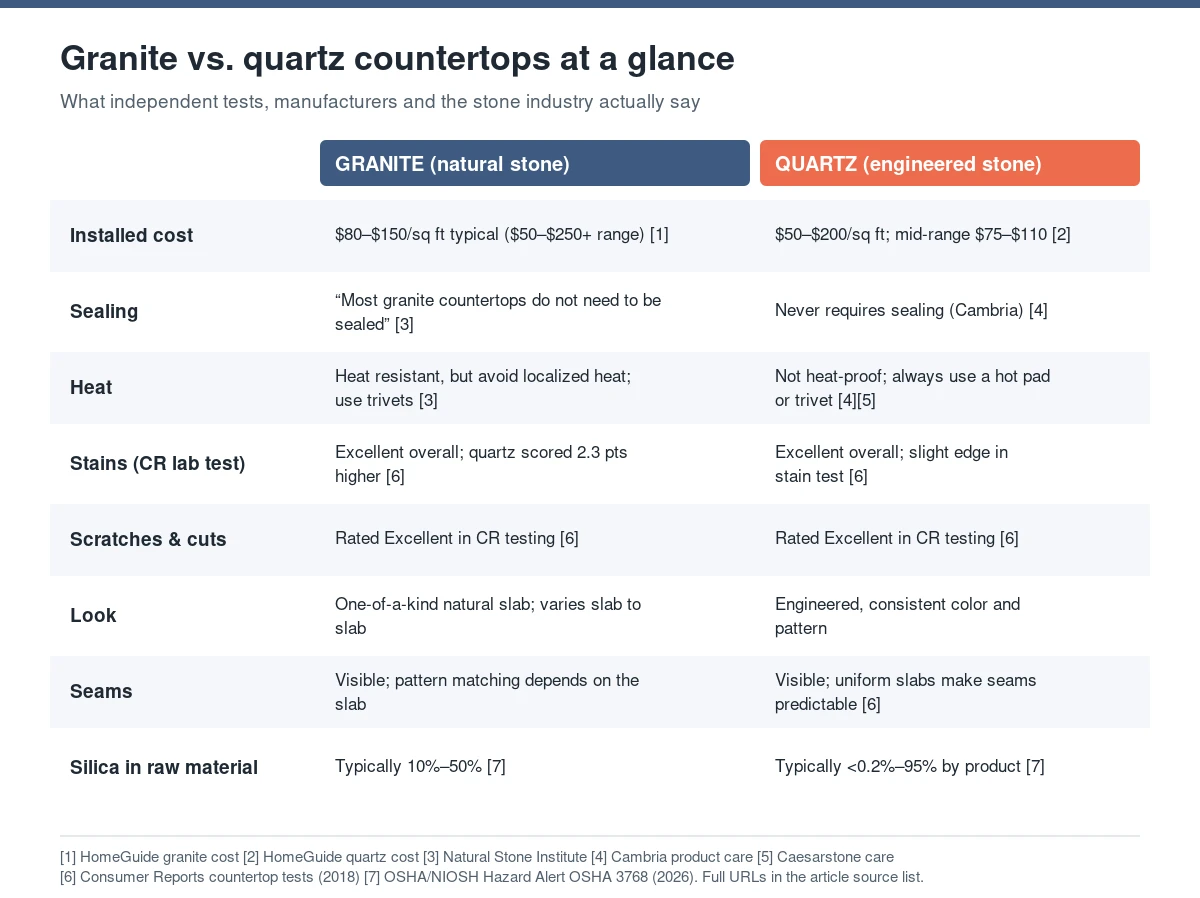
| Factor | Granite (natural stone) | Quartz (engineered stone) |
|---|---|---|
| Installed cost | $80–$150 per sq ft typical; $50 to $250+ overall (HomeGuide) | $50–$200 per sq ft; low $50–$95, mid $75–$110, high $90–$200 (HomeGuide) |
| Cutting, scratches, abrasion | Rated Excellent (Consumer Reports) | Rated Excellent (Consumer Reports) |
| Heat | No marks from a 400°F pan in CR testing. NSI: heat resistant, but avoid localized heat; use trivets | No marks from a 400°F pan in CR testing. Manufacturers: not heat-proof; always use a trivet or hot pad |
| Stains | Strong resistance; slightly behind quartz with beet juice and food coloring (CR) | Strong resistance; scored 2.3 points higher (out of 100) in CR's stain test |
| Chipping | Edges can chip if struck hard (CR) | Edges can chip if struck hard (CR) |
| Sealing | NSI: most granite countertops do not need to be sealed; test yours | Never requires sealing (Cambria); do not apply sealers |
| Daily cleaning | Neutral cleaner or mild dish soap and warm water (NSI) | Warm water and mild soap or pH-neutral cleaner (Cambria, Caesarstone) |
| Look | Every slab is unique; natural crystals and movement | Uniform, predictable color; many marble-look options |
| Seams | Visible; matching depends on the slab | Visible, but uniform pattern makes seam placement predictable (CR) |
| Crystalline silica in raw material | Typically 10%–50% (OSHA/NIOSH) | Typically <0.2%–95% depending on the product (OSHA/NIOSH) |
| Resale appeal | No published data on countertop-only resale value | No published data on countertop-only resale value |
Sources: Consumer Reports (Aug. 2018); HomeGuide granite; HomeGuide quartz; Natural Stone Institute; Cambria; Caesarstone; OSHA/NIOSH.
Cost: granite vs. quartz
On price the two materials overlap almost completely. HomeGuide puts granite at $80–$150 per square foot installed for most projects and quartz at $50–$200, with mid-range quartz at about $75–$110. HomeGuide’s installed ranges by brand are roughly $50–$100 per square foot for Caesarstone, $60–$125 for Cambria and $60–$140 for Silestone. Consumer Reports reached a similar conclusion in 2018: both materials cost “about the same,” with average installation running $40 to $100 per square foot depending on contractor and location.
In practice, an entry-level granite will usually undercut a designer quartz, and an exotic granite can cost far more than a basic quartz. Compare specific slabs, not categories.
Durability and heat
In Consumer Reports testing, both granite and quartz earned Excellent ratings for resistance to cutting, abrasion and heat. Neither showed burn marks after a weighted 400°F saucepan of hot shortening sat on the surface. Both can chip at the edges if you drop something heavy on them.
Manufacturers and the stone industry still advise caution with heat, for different reasons. The Natural Stone Institute (NSI) says granite is heat resistant to roughly 480°F (about 250°C) but discourages localized heat: a very hot pan on cold stone creates a temperature gradient that can crack it. Quartz contains resin, and Cambria says its surfaces are “not heat-proof, chemical-proof, or fracture-proof,” recommending a hot pad or trivet. Caesarstone also says to always use trivets for hot cookware. Bottom line: use a trivet on either material.
Stains and sealing
Granite is slightly porous. NSI reports typical absorption of about 0.05% to 0.40% by weight, depending on the stone. That doesn’t mean it needs frequent sealing. NSI’s position on sealing is direct: “Most granite countertops do not need to be sealed.” Many granites receive a resin treatment at the factory, and NSI says a quality sealer, when needed, should have a life expectancy of 10 to 15 years. Cost guides are less consistent. HomeGuide, for example, says sealing frequency ranges from several times a year to once every 10+ years depending on the stone. The practical answer is that it depends on the slab. Ask your fabricator whether your specific slab was resin-treated and whether it needs a sealer at all.
Quartz is non-porous and, according to Cambria, never needs sealing; Cambria actually advises against applying sealers. In CR’s 20-hour stain test, quartz scored 2.3 points higher (out of 100) than granite. Its edge came from stubborn stains like beet juice and food coloring. Both resisted coffee, oil, grape juice and many other common stains.
Looks and seams
This is where most people actually decide. Every granite slab is unique, with its own crystals, flecks and movement. Many buyers love that; for others, it’s why they pick out their exact slab in person. Quartz is manufactured, so it is consistent from sample to slab, and it comes in many solid colors and marble-look patterns. As Consumer Reports put it, quoting a National Kitchen & Bath Association trends specialist, with quartz “you can count on where the seams will be.”
Popularity and resale
Survey results point in different directions. In 2018, Consumer Reports cited a National Kitchen & Bath Association survey in which most people installing countertops chose quartz. In Angi’s survey of 8,100 customers, 44.6% said they preferred granite and 29.3% quartz. We found no reliable published data showing that one material adds more resale value than the other. Choose the surface you’ll enjoy living with, and keep the overall kitchen in good condition.
Silica safety: what homeowners should know
This is a fabrication-worker issue, not a reason to fear the countertop in your kitchen, but it’s worth knowing when you choose a fabricator. Cutting, grinding and polishing stone releases respirable crystalline silica dust. Breathing that dust can cause silicosis, an incurable lung disease. A 2026 OSHA and NIOSH Hazard Alert on countertop work lists typical crystalline silica content by material. Engineered stone ranges from under 0.2% to 95%, depending on the product. Granite typically contains 10%–50%, quartzite 95% or more, and marble or limestone under 5%.
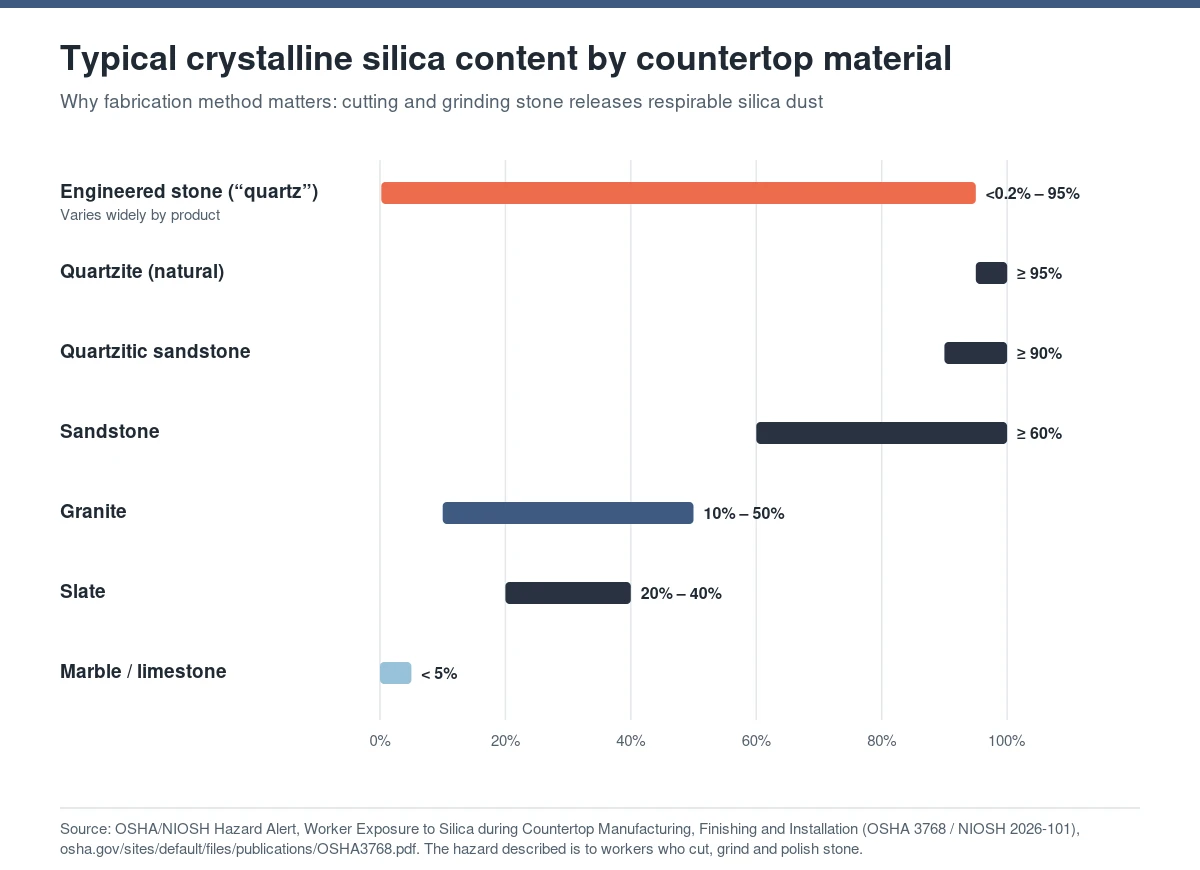
The CDC’s 2019 MMWR report described 18 cases of silicosis among engineered stone fabrication workers, including the first two reported U.S. deaths. A 2023 study in JAMA Internal Medicine identified 52 cases among California engineered stone workers; 10 of those patients (19%) died. OSHA’s silica standards (29 CFR 1910.1053 for general industry and 1926.1153 for construction) set a permissible exposure limit of 50 µg/m³ averaged over an 8-hour shift. The hazard alert describes controls such as wet methods, local exhaust ventilation and, where needed, respirators.
What this means for you as a buyer:
- Ask the fabricator how it controls silica dust in its shop: wet cutting, local exhaust ventilation and a written exposure control plan.
- Ask whether any cutting or grinding will happen in your home. The OSHA/NIOSH alert notes that exposure can occur during on-site finishing and installation, not just in the shop. If on-site cuts are needed, ask how dust will be controlled.
- If you’re choosing quartz, ask for the product’s safety data sheet, which lists its silica content. The OSHA/NIOSH alert tells fabricators to verify silica content this way, and its own range (from under 0.2%) shows that some engineered products contain very little.
Verdict: granite or quartz?
- Choose granite if you want a one-of-a-kind natural slab, like to pick your exact stone, cook with a lot of heat (still use trivets), or want a broad price range from entry-level to exotic.
- Choose quartz if you want a consistent color or marble-look pattern, the lowest-maintenance surface with no sealing, or a slight edge on stubborn stains.
- Either is a sound choice for durability, according to Consumer Reports’ testing. Budget, looks and how you use the kitchen should decide.
Still weighing other stones? Compare quartzite and marble, or read our guide to kitchen countertop materials.
How to care for granite and quartz countertops
Most of the long life of a stone countertop comes down to a few habits.
Daily cleaning
- Granite: NSI’s care guidance recommends a neutral cleaner, a stone soap or a mild dish soap with warm water, then rinse and dry with a soft cloth. Blot spills right away instead of wiping, which can spread them.
- Quartz: Cambria recommends warm water and mild soap. Caesarstone recommends mild soap or a pH-neutral cleaner, and says to avoid oven cleaners, dishwasher detergent and cleaners made for natural stone.
What to avoid
- On granite: Avoid acidic or abrasive cleaners. NSI warns that rust removers containing hydrofluoric acid attack granite. NSI also reminds readers never to mix bleach and ammonia.
- On quartz: Avoid high heat, harsh chemicals and sealers, per Cambria and Caesarstone. Honed and textured quartz finishes show marks more readily and may need more frequent cleaning, Caesarstone says.
- On both: Use trivets for hot cookware, cut on a board, and don’t stand or sit on unsupported overhangs or edges.
Should you seal granite?
Start from NSI’s view that most granite countertops don’t need sealing. If your fabricator recommends a sealer for a specific, more absorbent stone, NSI advises an impregnating, oleophobic (oil-repelling) sealer that is safe for food-contact surfaces. Remember that sealers make stone stain-resistant, not stain-proof. Spills still need prompt cleanup. HomeGuide lists professional sealing at about $200–$350 per treatment; NSI notes a good sealer should last 10 to 15 years.
How to choose your granite: a step-by-step checklist
- Measure and sketch. Calculate square footage as described above, and note sink, cooktop and outlet locations.
- Set a budget range. Use the kitchen-size table, then add removal, edges, cutouts, backsplash and plumbing.
- See full slabs, not just samples. Granite varies within a single slab. Look at the exact slab you’re buying, in natural light if possible.
- Check your cabinets. Stone needs level, sound cabinets. Fix or replace weak boxes before templating.
- Choose thickness and edge. Decide between 2 cm and 3 cm, and pick an edge profile that suits your kitchen and budget.
- Approve the seam plan. Ask where seams will go and how veining will be matched.
- Confirm sink and faucet models. Undermount sinks need the actual sink, or its template, at fabrication.
- Ask about sealing. Find out whether your slab was resin-treated and whether a sealer is recommended.
- Get it in writing. Request an itemized quote listing stone, square footage, edge, cutouts, removal, backsplash and any plumbing.
Questions to ask a countertop fabricator
- Is the quote priced per finished square foot or per slab? Who keeps the remnants?
- What exactly is included: templating, delivery, removal, cutouts, edges, backsplash, sink mounting, plumbing reconnection?
- Can I see and approve my actual slab and seam layout before cutting?
- How do you control silica dust in the shop, and will any cutting or grinding happen in my home?
- Are you accredited by the Natural Stone Institute? HomeGuide suggests asking.
- Are my cabinets strong and level enough for stone, and does any of this work need a permit?
- Are you licensed and insured? In Maryland, check the Maryland Home Improvement Commission license lookup.
- What warranty covers fabrication and installation, and for how long?
- What care routine do you recommend for this exact stone?
Is granite a good investment? ROI and resale
Nobody publishes a reliable “return on investment” figure for countertops alone. The closest credible data is the Remodeling 2025 Cost vs. Value Report, which estimates what share of a project’s cost is reflected in resale value. In the Washington, DC market, a midrange minor kitchen remodel had an estimated job cost of $27,308 and resale value of $27,450, about 100.5% of cost recouped. Nationally the figure was 112.9%. A midrange major kitchen remodel recouped an estimated 48.9% in the DC market.
| Project | Job cost | Resale value | Cost recouped (DC) | Cost recouped (national) |
|---|---|---|---|---|
| Minor kitchen remodel, midrange | $27,308 | $27,450 | 100.5% | 112.9% |
| Major kitchen remodel, midrange | $79,988 | See report | 48.9% | 50.9% |
| Major kitchen remodel, upscale | $160,104 | See report | 32.4% | 35.7% |
Source: Remodeling 2025 Cost vs. Value Report, Washington, DC. © 2025 Zonda Media, a Delaware corporation. Complete data from the Remodeling 2025 Cost vs. Value Report can be downloaded free at www.costvsvalue.com.
The pattern is consistent: modest, well-chosen updates recover more of their cost at resale than large luxury overhauls. A countertop upgrade on sound cabinets is exactly that kind of update. NSI argues that granite “should, and in most cases will, be the last countertop surface a person will buy,” and HomeGuide estimates that granite countertops can last 100+ years when installed and maintained correctly. Those are industry views, not measured returns, but they reflect how long the material lasts with basic care.
Replacing countertops with GBC Kitchen & Bath
GBC Kitchen & Bath’s countertop service covers measurement, fabrication and installation. The service page lists granite, quartz, marble and quartzite. It also covers custom and mitered island edges, waterfall edges, undermount sink and outlet cutouts, and backsplash integration. Full slabs and samples are on display in our showrooms, so you can compare stones side by side before you choose. Every proposal includes a clear countertop allowance. Countertop replacement can be booked on its own or as part of a full kitchen remodel. If the cabinets underneath need attention first, see our cabinet options.
Our four-step process runs from initial consultation through design and planning, project execution and a final walkthrough. GBC’s kitchen, bathroom and basement remodeling projects carry a three-year workmanship warranty. GBC is licensed in Maryland under MHIC #135112. You can confirm that on the Maryland Home Improvement Commission’s public lookup.
Visit a showroom to see full slabs:
- Alexandria, VA: 5601 General Washington Dr, Unit H, Alexandria, VA 22312 · (703) 750-1188 · Showroom details
- Ashburn, VA: 44031 Ashburn Shopping Plaza, Suite 275, Ashburn, VA 20147 · (703) 520-7990 · Showroom details
- Columbia, MD: 9204 Berger Rd, Ste E, Columbia, MD 21046 · (410) 417-6060 · Showroom details
- Rockville, MD: 1055 Rockville Pike, Rockville, MD 20852 · (301) 309-3520 · Showroom details
Ready for real numbers? Request a free in-home estimate and we’ll measure your kitchen and give you an itemized quote.
Sources
- HomeGuide, Granite countertops cost and Quartz countertops cost
- Angi, How much do granite countertops cost? (updated July 2026)
- Consumer Reports, Quartz vs. granite (Aug. 17, 2018)
- Natural Stone Institute, Sealing stone, Granite and Stone care
- Cambria, Product care; Caesarstone, Care and maintenance
- OSHA/NIOSH, Hazard Alert: Worker exposure to silica during countertop manufacturing, finishing and installation; OSHA, Crystalline silica
- CDC, MMWR, Severe silicosis in engineered stone fabrication workers (2019); JAMA Internal Medicine, Silicosis among immigrant engineered stone workers in California (2023)
- U.S. Geological Survey, Mineral Commodity Summaries 2026: Dimension stone
- Remodeling, 2025 Cost vs. Value Report, Washington, DC
- U.S. Bureau of Economic Analysis, Regional Price Parities via FRED (Maryland, Virginia, District of Columbia)
