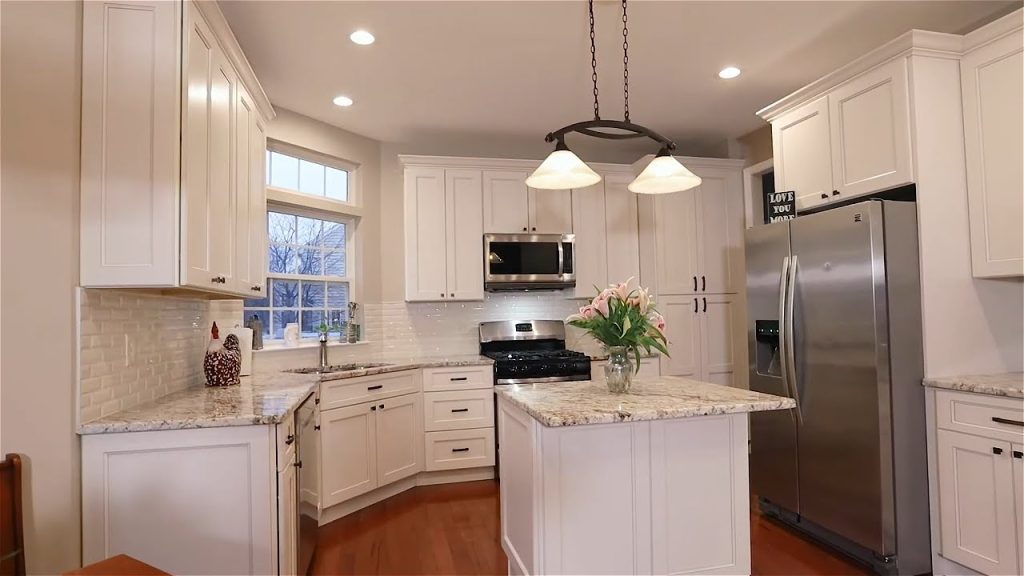
Key Takeaway: A kitchen remodel in Fairfax, Loudoun, Montgomery, or Howard County often needs a building permit, trade permits, or both once the work goes beyond cabinets, countertops, and finish surfaces. Fairfax County lists kitchen renovations under interior alterations that require a permit, and it separately lists kitchen cabinets and/or countertops among work that does not need an LDS permit. Montgomery County requires a permit for renovation other than a repair, and it exempts items such as countertops, cabinets, and new floor finishes when there is no structural change. Confirm the parcel’s jurisdiction, file complete drawings, and do not treat an HOA or town approval as a substitute for the county or city permit.
The short answer is that many kitchen remodels need a permit, but not every kitchen update does. The dividing line in these four counties is usually whether you are only replacing cabinets, counters, and finishes, or whether you are changing walls, plumbing, electrical, gas, or mechanical systems. The details differ by office, and the mailing city on your envelope is not always the office that issues the permit.
This guide covers Fairfax County and Loudoun County in Virginia, and Montgomery County and Howard County in Maryland, the counties around GBC Kitchen & Bath’s Alexandria, Ashburn, Rockville, and Columbia showrooms. For Arlington County, use the existing Arlington kitchen remodeling permits guide. For a finished basement, use the basement finishing permits guide. For how permits sit on the project calendar, see how long a kitchen remodel takes.
None of the figures below is a GBC fee or a GBC promise. Always confirm the current rule, fee, and review path with the office that has jurisdiction over the property.
Which Office Issues Your Kitchen Permit?
Start with the parcel, not the mailing address. Independent cities and some towns run their own building offices. The City of Alexandria, the City of Fairfax, and the City of Falls Church are examples of separate Virginia offices. Incorporated towns in Loudoun County require an approved town zoning permit with the county application. Montgomery County notes that a municipality may add its own permission, and that the county does not enforce private covenants. In Howard County, Columbia village architectural review, when it applies to exterior work on Columbia Association assessed property, is a separate process from the county permit.
| If the property is in | Building permit office to start with | How applications are commonly filed | Notes to confirm |
|---|---|---|---|
| Fairfax County (not an independent city) | Fairfax County Land Development Services | Online in PLUS, under a residential addition/alteration record, including interior alterations with or without structural changes | Zoning, site, Health, or other agency reviews may still apply. Fast Track may be available for minor interior alterations if staff agree the project is eligible. |
| Loudoun County | Department of Building and Development | Online in LandMARC as a Residential Alteration, or in person in Leesburg | If the lot is in an incorporated town, submit an approved town zoning permit with the application. Gas permits for residential alterations and additions have required plan review as of October 1, 2025. |
| Montgomery County | Department of Permitting Services | Electronic application and ePlans | Plumbing and gas work may also need WSSC review. Fast Track interior alterations may not include load-bearing walls. HOA covenants are not enforced by the county. |
| Howard County | Department of Inspections, Licenses and Permits | Online Citizen Access Portal; some plan sets go to ProjectDox by invitation | The sample handout treats a kitchen remodel as an interior alteration building permit and asks for existing and proposed floor plans. Engineer calculations are required if load-bearing walls are removed. |
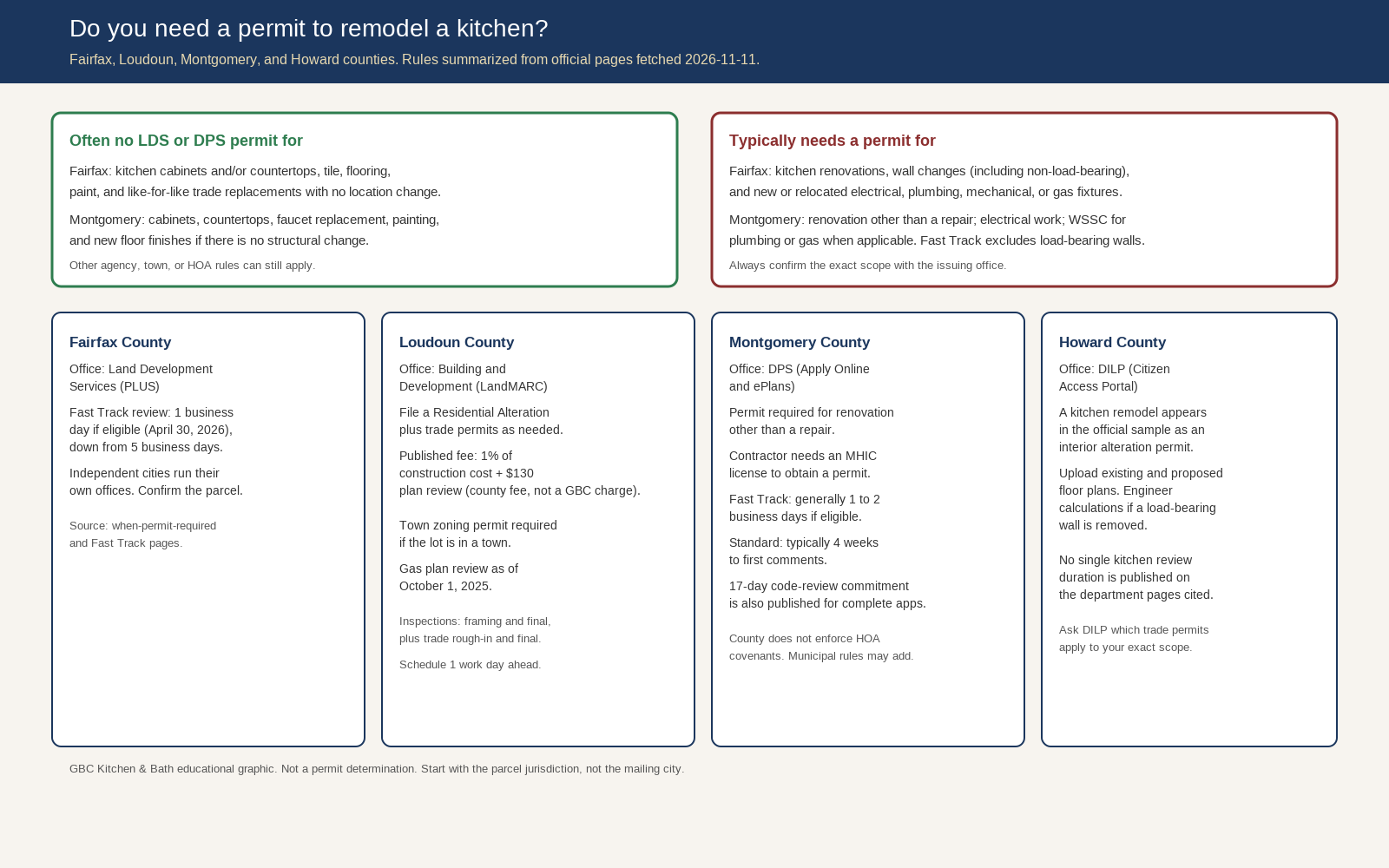
When Does a Kitchen Remodel Need a Permit?
Fairfax County
Fairfax County’s “Does My Project Require a Permit?” page is the clearest local list for kitchens.
Work the county lists as requiring a permit, with kitchen examples drawn from that page:
- Interior alterations and renovations, which expressly include kitchen renovations, bathroom remodels, removing an existing wall, building new walls, and new window or door openings. The same item includes installation or removal of non-load-bearing or non-structural walls.
- New, repair, or relocated electrical fixtures, including lights, outlets, switches, panels, and ovens.
- New, repair, or relocated mechanical or gas fixtures, including duct work, a range hood, and HVAC.
- New, repair, or relocated plumbing or gas fixtures, including disposals, sinks, stoves, ranges, water heaters, and connecting or disconnecting water or sewer.
- Direct replacement of household appliances, including stoves, ovens, water heaters, and HVAC.
Work the county lists as not requiring an LDS permit, again from that page:
- Kitchen cabinets and/or countertops
- Replacement of tiles
- Replacement of flooring material
- Painting and/or wallpaper
- Direct replacement of electrical, plumbing, and mechanical work with no change in location, when the replacement is like-for-like
- Direct replacement of existing windows and doors
The county also warns that other approvals can still apply even when an LDS permit is not required, including zoning. If your project is only new doors on existing boxes, cabinet refacing may stay on the no-permit side of that list, but any new circuits, relocated plumbing, or wall work brings you back to the permit-required list.
Montgomery County
Montgomery County DPS says a permit is required before reconstruction or renovation to an existing structure other than a repair. Reconstruction includes partial demolition that does not require a demolition permit, and rebuilding.
The same page says a permit is not required for painting, wallpapering, replacing a faucet, installing countertops, or installing hardwood floors, tiles, or carpeting if no structural changes are performed.
The home improvements page lists interior alteration and electrical work among projects that will likely need a permit. It lists cabinets (install, repair, replace) and floor coverings among work that most likely will not. Electrical plug receptacles may be repaired or replaced in the same location without a permit. The page notes that municipal and homeowner association rules can still apply, and that work exempt from a permit must not violate the building code or other ordinances.
If the kitchen work includes a load-bearing wall, it is not eligible for Residential Fast Track, which otherwise can be a shorter path for qualifying interior alterations.
Loudoun County
Loudoun County treats a change in the use of existing square footage as a residential alteration. The application must be signed by the property owner and must state the square feet of area being disturbed. Building plans must detail all structural elements. Residential trade permits for electrical, gas, mechanical, and plumbing are listed as additional documentation. Plan review is required for gas permits for residential alterations and additions as of October 1, 2025.
Published alteration fees on that page are a building permit fee based on 1 percent of construction costs, plus a $130 plan review fee. That is a county fee schedule item, not a flat kitchen price and not a GBC charge.
If the property is in an incorporated town, an approved town zoning permit must be submitted with the application. Health Department approval is required if a bedroom is being added on a well-and-septic lot, which is less common in a kitchen-only project but matters if the kitchen work is combined with other rooms.
Howard County
Howard County DILP issues building, mechanical, plumbing, electrical, and related permits through its department page and the Citizen Access Portal. The county’s sample residential building permit handout (dated 11.05.2025) includes an interior alteration example whose description of work is a first-floor kitchen remodel that removes one load-bearing wall between the kitchen and dining room. Required uploads for that record type include existing and proposed floor plans, a plot plan if new exterior openings are added, and engineer calculations if load-bearing walls are removed.
That sample is evidence that a kitchen remodel is filed as an interior alteration building permit in Howard County. It is not a claim that every cosmetic update needs the same record. Ask DILP which permits apply to a cabinets-and-counters-only scope, and file trade permits for plumbing, electrical, mechanical, or gas work when those systems change.
What Inspections Should You Expect?
Do not close walls, set cabinets that hide rough-in, or finish the room until the required rough-in inspections have passed. The exact list depends on the trades in the permit.
| County | Inspection notes from official pages fetched 2026-11-11 |
|---|---|
| Fairfax County | Follow the inspections listed on the issued PLUS record and the approved drawings. The county’s process pages describe technical review and issuance; your contractor should request each required inspection at the correct stage. |
| Loudoun County | For alterations, building inspections are framing and final. Trade permits are inspected at rough-in and final for electrical, plumbing, mechanical, and gas as applicable. Approved plans must be on site or the inspection will not be performed. Inspections must be scheduled one work day in advance. |
| Montgomery County | Inspections are requested at least 24 hours before the date needed and can be scheduled online with the permit number and Contact ID. Work must conform to the approved drawings. The permit stays on site until completion. |
| Howard County | See DILP’s inspection requirements and the conditions on the issued permit. Request inspections through the county’s published request line or portal. |
A failed inspection adds a correction and a reinspection before the next phase can start. That is one reason the kitchen remodel timeline treats inspections as holds, not as paperwork to finish after the room is in use.
Who Should Be Named on the Permit?
Montgomery County allows a homeowner to apply in their own name, but if a contractor will perform the work, DPS strongly suggests listing the contractor as the responsible party. A contractor must have a Maryland Home Improvement Commission license to obtain a permit.
Howard County’s adopted contractor-licensing language, quoted on the DILP page, says homeowners of one- and two-family dwellings may act as their own general contractor for alterations and additions if they own the property and it is their primary residence. If the property is a rental or is not their primary residence, they must have a Maryland Home Improvement Contractors License or a Maryland Home Builders License in accordance with state licensing laws.
Loudoun County requires the building permit application to be signed by the property owner. If you are hiring a contractor, ask that person which licenses the county or town will expect to see, and who will schedule inspections.
This guide does not state a Fairfax County applicant rule beyond what is on the pages cited above. Ask LDS who should be listed on a PLUS kitchen alteration record for your property.
What Should You Have Ready Before You Apply?
- Existing and proposed floor plans, with rooms labeled and any wall changes marked
- Structural calculations or a licensed design professional’s drawings, if a load-bearing wall will be removed or a new opening is cut
- Trade drawings or fixture counts for electrical, plumbing, gas, and mechanical work
- A square-footage figure for the disturbed area, required on Loudoun County alteration applications
- Town zoning approval, if you are in an incorporated Loudoun town
- HOA, condo, or village architectural approval, if your community requires it (this is separate from the public permit)
- Product information that affects connections, such as a gas range, a downdraft, or a new electrical load
- Owner signature and, in Maryland, the contractor license number when a contractor is applying or is required to be listed
If you are adding an island with a sink or cooktop, show the new utilities on the plan. The kitchen island guide explains why those connections change both design and permitting.
Planning a Kitchen Remodel in Northern Virginia or Maryland?
See our kitchen remodeling service page for what GBC Kitchen & Bath offers in kitchens and the areas it serves. Cost ranges, which are a separate question from permits, are in the Northern Virginia and Maryland kitchen cost guides.
When you are ready, contact us with your existing and proposed layout, and bring the checklist above to any design conversation. For how GBC describes its own steps, see the process page.
Showroom locations, as listed on the contact page:
- Alexandria: 5601 General Washington Dr Unit H, Alexandria, VA 22312. Phone (703) 750-1188. Hours Monday to Friday 9 a.m. to 6 p.m., Saturday 10 a.m. to 4 p.m.
- Rockville: 1055 Rockville Pike, Rockville, MD 20852. Phone (301) 309-3520. Hours Monday to Friday 9 a.m. to 5 p.m., Saturday 10 a.m. to 4 p.m.
- Ashburn: 44031 Ashburn Shopping Plaza Suite 275, Ashburn, VA 20147. Phone (703) 520-7990. Hours Monday to Friday 9 a.m. to 6 p.m., Saturday 10 a.m. to 4 p.m.
- Columbia: 9204 Berger Rd Ste E, Columbia, MD 21046. Phone (410) 417-6060. Hours Monday to Friday 9 a.m. to 5 p.m., Saturday 10 a.m. to 3 p.m.
Main phone: (844) 644-4422. Email: info@gbcdc.com.
