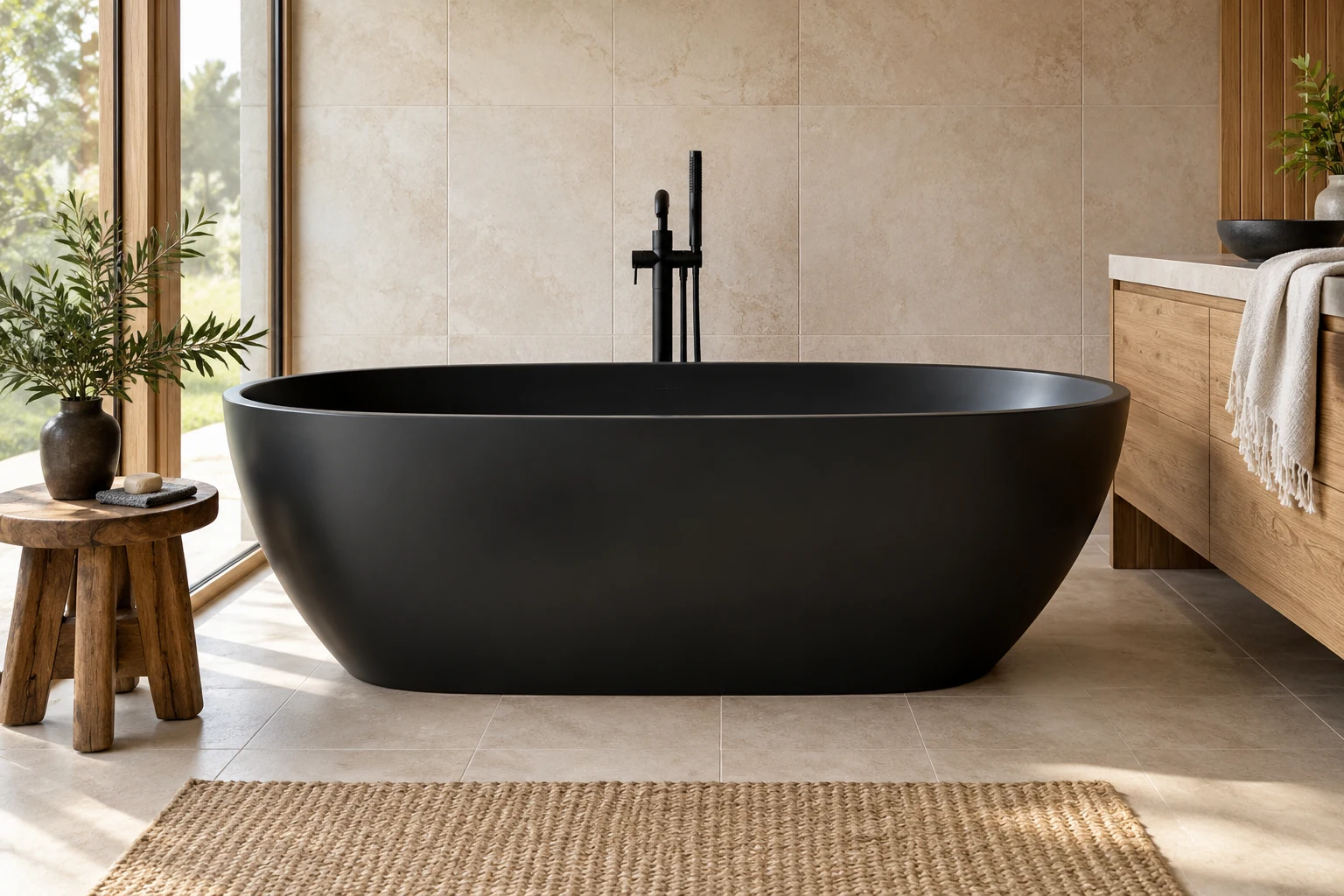
A black bathtub is a bathtub with a black interior, a black exterior, or both. You can get one in acrylic, enameled cast iron, stone resin (solid surface), copper and a few other materials. Angi's 2026 data puts most bathtub replacement projects between $2,104 and $9,756, with a national average of $5,929. Where your project lands depends far more on the material, the tub style and the work around the tub than on the color. A black tub is no harder to own than a white one, but it shows different things. Dust, soap film and hard-water residue stand out on black, while small chips that would vanish on white can show on a painted finish. This guide covers the materials, finishes, real prices, installation questions, cleaning and design choices, and every number links to its source.
Key takeaways
- Check where the black actually is. Some black tubs are black inside and out. Many have a white interior with a painted black exterior, and that paint can carry a shorter warranty than the tub itself.
- The water weighs more than the tub. A filled soaking tub can pass 1,000 lb. Even a 138 lb acrylic tub has a manufacturer floor-load rating above what a lighter cast iron model needs.
- Matte and gloss need different care. You can polish gloss. You should not polish matte painted finishes.
- Freestanding tubs cost more to install than the tub price suggests. They often need a drain through the floor, a floor- or wall-mounted filler and more open floor space.
- Keep one tub in the house. Consumer Reports and Angi both say buyers expect at least one bathtub.
What is a black bathtub, and where does the black come from?
A black bathtub can be black in three different ways. The answer changes how it looks up close, how it ages and what its warranty covers.
- Black all the way through, or a black interior surface. On Kohler's Artifacts freestanding bath (K-21000-P5), the interior enamel comes in a color called Black Black (color code 7), and the exterior is painted in Iron Black, according to Kohler's spec sheet. You see black when you sit in the tub, not just when you walk past it.
- A white interior with a painted black exterior. This is common on stone resin tubs. Victoria + Albert's Lussari, for example, lists Gloss White and Matte White as standard finishes, with "optional RAL colors available" for the outside. Its spec sheet states a 25-year residential guarantee for the tub, but the "paint finish exterior guaranteed for 2 years." That difference matters if you are paying extra for the black.
- A metal finish that darkens naturally. Copper is a "living metal that will naturally patina over time," as Native Trails explains in its care guide. Dark antique copper reads as near-black in some light, but it is not a paint and it will keep changing.
Before you fall in love with a photo, ask three questions: Is the inside black or white? Is the black a paint, an enamel, a gelcoat or the material itself? What warranty applies to the color, as opposed to the tub? The spec sheet usually answers all three.
Which material is best for a black bathtub?
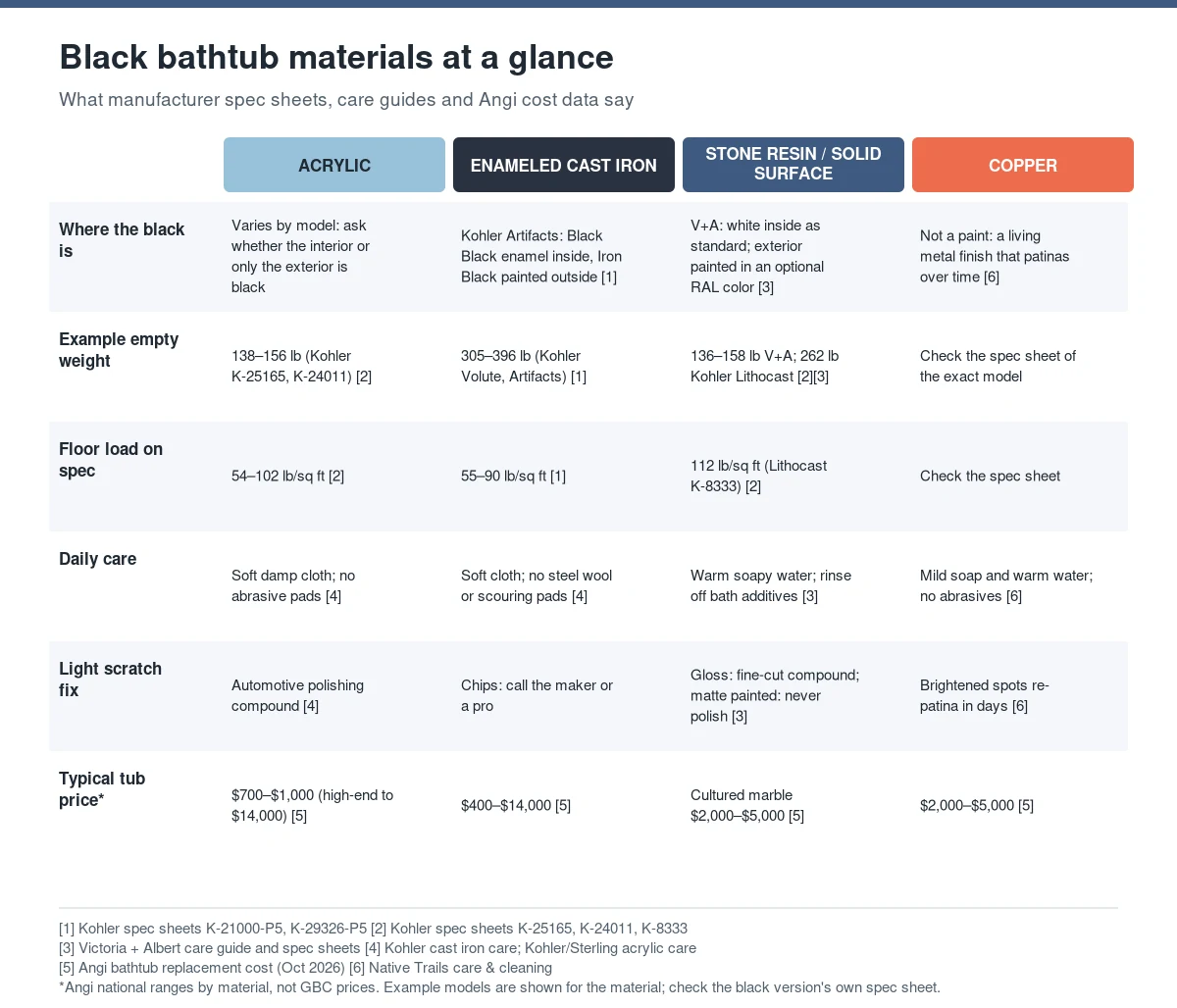
No single material is best. Each one trades weight, feel, price and repairability differently. Kohler's bath buying guide describes enameled cast iron as having an extra-thick enamel and acrylic as resistant to chipping. It also lists Lithocast, a cast acrylic solid surface material. The table below sets the four main options side by side using manufacturer spec sheets for real models.
Black bathtub materials compared (example models from manufacturer spec sheets)
| Material | Example model | Empty weight | Water capacity | Manufacturer minimum floor load |
|---|---|---|---|---|
| Acrylic | Kohler K-25165 (66 x 30 in) | 138 lb | 78.7 gal | 102 lb/sq ft |
| Acrylic | Kohler Stargaze K-24011 | 156 lb | 60 gal | 54 lb/sq ft |
| Enameled cast iron | Kohler Artifacts K-21000-P5 (Black Black interior, Iron Black exterior) | 396.2 lb | 69 gal | 90 lb/sq ft |
| Enameled cast iron | Kohler Volute K-29326-P5 (Iron Black exterior) | 305 lb | 42.45 gal | 55.2 lb/sq ft |
| Solid surface (cast resin) | Kohler Memoirs K-8333 (Lithocast) | 262 lb | 98.74 gal | 112.2 lb/sq ft |
| Stone resin | Victoria + Albert Barcelona (Volcanic Limestone) | 136 lb | 43 gal | Not listed |
| Stone resin | Victoria + Albert Lussari (Volcanic Limestone) | 158 lb | 103 gal | Not listed |
Sources: Kohler spec sheets K-25165, K-24011, K-21000-P5, K-29326-P5, K-8333; Victoria + Albert spec sheets for Barcelona and Lussari. The acrylic and Lithocast examples are shown for the material; check the spec sheet of the exact black model you choose.
Acrylic
Acrylic is the lightest common option and usually the least expensive. Angi lists standard acrylic tubs at $700 to $1,000, with high-end models reaching $14,000, and calls the material "lightweight and resilient." The trade-off is lifespan. In the same Angi cost guide, acrylic and fiberglass tubs last about 10 to 15 years, against roughly 20 years as a general replacement point. Light scratches and dull spots on acrylic can often be buffed out, which matters more on black, where scuffs show as gray haze.
Enameled cast iron
Cast iron is the heavyweight. Kohler's black Artifacts tub weighs 396.2 lb empty and the Volute weighs 305 lb. Angi notes that cast iron offers "excellent heat retention and a rigid, noise-free experience" and that "your pro may need to add structural reinforcements before installation." Cast iron spans a wide price band: $400 to $14,000, according to Angi. Kohler pairs its enameled cast iron baths with a "Lifetime Limited Warranty" on the spec sheet. The glossy enamel surface is hard, but a dropped object can chip it, and a chip in black enamel can expose the metal underneath.
Stone resin and solid surface
Stone resin (Victoria + Albert calls its version Volcanic Limestone) and cast solid surface (Kohler's Lithocast) give you the thick-walled, sculptural look of stone with less weight than cast iron. The Barcelona weighs 136 lb and the Lussari 158 lb, per V+A's spec sheets. These materials can usually be sanded and polished to remove light scratches, which is a real advantage for a dark tub. Many are white inside with the black applied to the exterior as paint, so check whether you are buying a black interior or a black shell. Angi does not list stone resin as a separate line. Its closest category, cultured marble, runs $2,000 to $5,000.
Copper and other metals
Copper tubs cost $2,000 to $5,000 on Angi's list. Angi says copper "retains heat exceptionally well." Native Trails' care guide describes a self-healing surface: if acidic substances such as lemon, ketchup or red wine brighten a spot, it "will naturally re-patina itself," usually within days. Copper suits homeowners who like a finish that changes over time. If you want a tub that stays exactly the same shade of black for 20 years, copper is the wrong pick.
Matte or gloss: which black finish is easier to live with?
Gloss is easier to restore. Matte is easier to damage by over-cleaning. The two finishes need opposite treatment when something goes wrong.
Victoria + Albert's care and cleaning guide is unusually specific:
- Gloss painted exteriors "can be cleaned with neutral soaps and warm water." Painted tubs ship with a bottle of touch-up paint in the same finish, and stubborn marks can be polished with a polishing kit from customer care.
- Matte painted finishes "should not be polished." Clean them with a specialist matte-finish cleaner such as Flitz, and don't press hard, "as this can remove the matte finish."
- Matte interiors (V+A's Matte White) can take a fine scouring pad such as a Magic Eraser for stubborn stains, and light scratches can be rubbed out with a scouring pad using light pressure.
- Gloss interiors can take a fine-cut automotive compound for light scratches. V+A also warns that regular abrasive cleaning "will cause the disappearance of the glossy look over a long period."
Kohler's cast iron instructions point the same way for glossy enamel: after cleaning, "for a bright shine, polish with a soft, dry cloth."
What does this mean in daily life? A gloss black tub reflects light, so streaks and drips can catch your eye. But you can buff and polish it back. A matte black tub hides reflections and looks soft, but it punishes the wrong cleaner. If several people with different cleaning habits share the bathroom, gloss is the more forgiving choice. If you want the matte look, put the care instructions where everyone will see them.
How much does a black bathtub cost?
Color rarely sets the price. Material and style do. Angi's 2026 data, based on 4,360 verified projects, puts the national average bathtub replacement at $5,929, with most homeowners paying $2,104 to $9,756. A basic swap can start around $220. A high-end clawfoot or custom tub can pass $15,000.
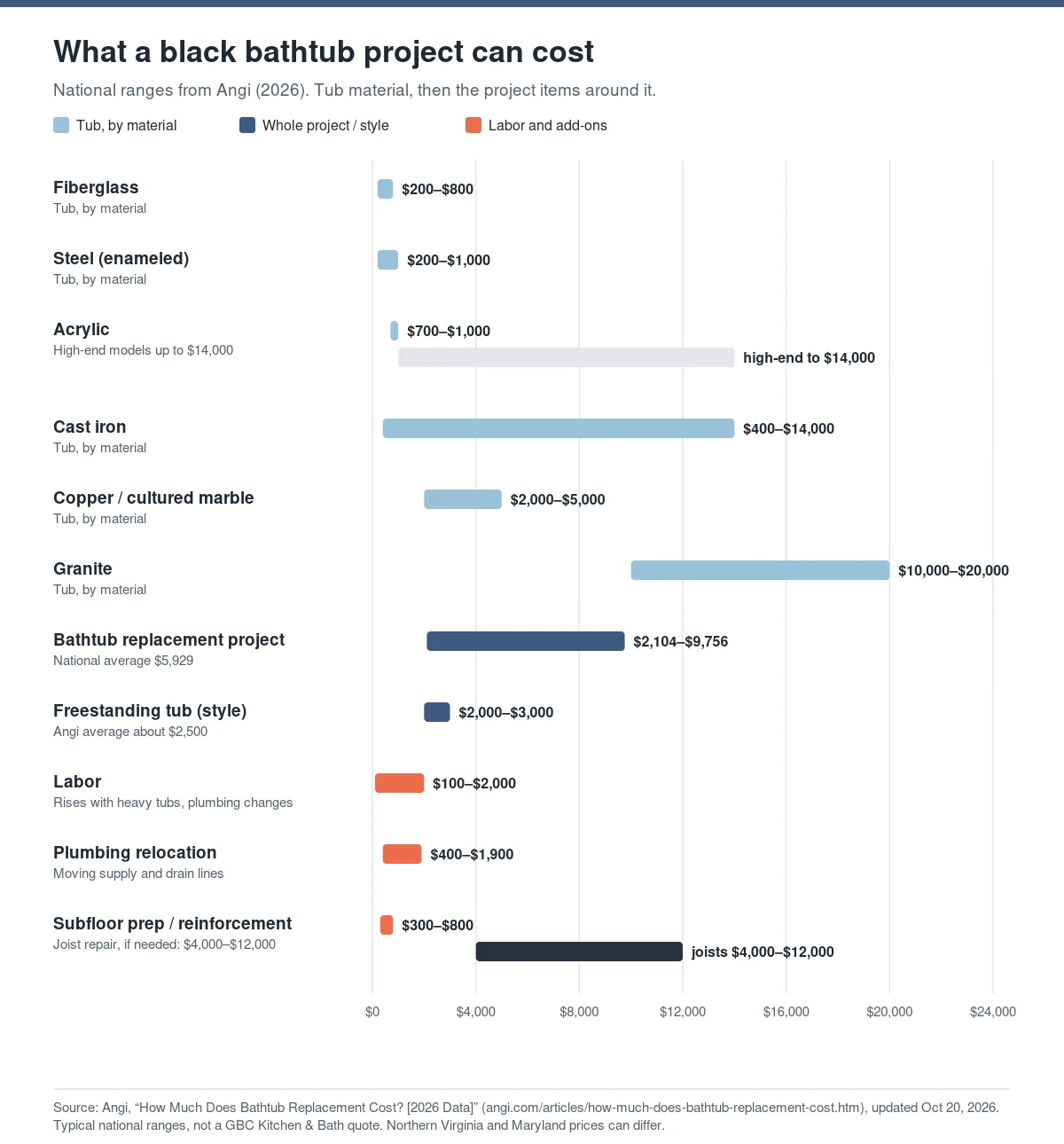
Bathtub cost by material and style (national ranges, 2026)
| Item | Typical range | Source |
|---|---|---|
| Fiberglass tub | $200–$800 | Angi |
| Enameled steel tub | $200–$1,000 | Angi |
| Acrylic tub | $700–$1,000 (high-end up to $14,000) | Angi |
| Cast iron tub | $400–$14,000 | Angi |
| Copper tub | $2,000–$5,000 | Angi |
| Cultured marble tub | $2,000–$5,000 | Angi |
| Granite tub | $10,000–$20,000 | Angi |
| Standard (alcove) tub | $200–$800 | Angi |
| Freestanding tub | $2,000–$3,000 (average about $2,500) | Angi |
| Soaking tub | $600–$13,000 | Angi |
| Built-in tub vs. custom freestanding | $200–$1,000 built-in; about $2,000 to $9,000+ for custom, stone, copper or wood freestanding | Angi |
| Whole bathtub replacement project | $2,104–$9,756 (average $5,929) | Angi |
Sources: Angi, How much does bathtub replacement cost? (updated Oct. 20, 2026); Angi, Freestanding vs. built-in bathtubs (updated July 8, 2026). Typical national ranges, not a GBC Kitchen & Bath quote.
Why are the ranges so wide? Each line covers everything from builder-grade to designer models. A black finish can sit at either end. Consumer Reports gave an older but useful reference point in its guide to cutting bathroom remodeling costs (2017): a new soaker tub "could cost $500 to $1,000 for the tub itself, plus hundreds more for installation." Use the tub price as a starting point only. The work around it usually costs more.
What drives the installation cost?
Five things move the installed price of a black tub far more than the finish does: the floor, the plumbing, the water heater, the old tub and the walls behind it.
Installation cost factors (national ranges, 2026)
| Cost factor | Typical range | When it applies |
|---|---|---|
| Labor to replace a tub | $100–$2,000 | Every project; higher for heavy tubs or plumbing changes |
| Plumbing relocation | $400–$1,900 | Switching tub type or moving the tub |
| Old tub removal and disposal | $150–$4,500 (cast iron haul-away $300+) | Every replacement |
| Subfloor prep and reinforcement | $300–$800 | Heavy tubs, soft or damaged subfloor |
| Floor joist repair | $4,000–$12,000 | Compromised joists under the tub |
| Water damage repair | $450–$14,000 (average about $3,850) | Hidden damage found when the old tub comes out |
| Tub surround (for tub-shower combos) | $500–$2,000 | Alcove tubs with a shower |
| Faucets and hardware | $50 to $900+ | Every project |
| Permits | $50–$500 plumbing; $10–$500 electrical | Plumbing or electrical changes |
Source: Angi, How much does bathtub replacement cost? (updated Oct. 20, 2026).
Floor load: why cast iron and big soakers need a structural check
When people worry about floor load, they usually think about cast iron. The bigger factor is water. The U.S. Geological Survey puts a gallon of water at 8.33 pounds. Multiply that by the capacity on a tub's spec sheet and add the empty weight:
Filled weight before a bather gets in (empty weight + spec capacity × 8.33 lb/gal)
| Example tub | Empty | Water at spec capacity | Total before bather |
|---|---|---|---|
| V+A Barcelona, stone resin, 43 gal | 136 lb | about 358 lb | about 494 lb |
| Kohler Stargaze K-24011, acrylic, 60 gal | 156 lb | about 500 lb | about 656 lb |
| Kohler Volute, cast iron, 42.45 gal | 305 lb | about 354 lb | about 659 lb |
| Kohler K-25165, acrylic, 78.7 gal | 138 lb | about 656 lb | about 794 lb |
| Kohler Artifacts, cast iron, 69 gal | 396.2 lb | about 575 lb | about 971 lb |
| V+A Lussari, stone resin, 103 gal | 158 lb | about 858 lb | about 1,016 lb |
| Kohler Memoirs K-8333, solid surface, 98.74 gal | 262 lb | about 822 lb | about 1,085 lb |
Calculation by GBC Kitchen & Bath from the manufacturer spec sheets above and the USGS figure of 8.33 lb per gallon. Spec capacity is the maker's stated capacity; a normal bath holds less, and the bather adds more.
The surprise is that a large acrylic soaker can load a floor more than a compact cast iron tub. Kohler's own ratings show this: the 138 lb acrylic K-25165 lists a minimum floor load of 102 lb/sq ft, while the 396 lb cast iron Artifacts lists 90 lb/sq ft.
Compare those ratings with the building code. The 2021 Virginia Residential Code, Table R301.5, which adopts the International Residential Code with amendments, sets a minimum design live load of 40 lb/sq ft for areas other than sleeping areas and 30 lb/sq ft for sleeping areas. That is a minimum for designing the whole floor, not a measure of what your floor can actually carry. Real capacity depends on joist size, spacing, span and condition. Still, when a tub's spec sheet asks for two to three times the code's design minimum, you need someone to look at the framing before you order. That person might be your contractor, and for an older floor or a long span, a structural engineer. Kohler's buying guide gives the same advice in plain terms: check the full-bath weight with your project team.
Drain and filler placement
An alcove tub has a wall at the head end for the faucet and the drain-overflow. A freestanding tub sits away from the walls, so its drain usually drops straight through the floor and its filler comes up from the floor or out of a nearby wall. Angi's freestanding vs. built-in comparison notes that freestanding tubs typically need plumbing rerouted through the floor. Read the spec sheet early, too. Many freestanding tubs need a specific drain sold separately. V+A's Barcelona, for example, requires its K-36E drain. On a second floor, routing a new drain means opening the ceiling below. On a slab, it means cutting concrete.
Water temperature and the water heater
Two plumbing rules apply to every new tub. First, the code limits how hot the tub filler can get. Section P2713.3 requires bathtub valves to have or be supplied by an ASSE 1070 water-temperature-limiting device set to no more than 120°F, unless they are compliant combination tub/shower valves. Second, a big soaker needs a lot of hot water. Kohler's spec sheets say "the hot water supply should be 70% of the capacity of the bath or greater." For a 69-gallon tub, that means roughly 48 gallons of hot water. A 79-gallon soaker needs about 55 gallons. If your water heater can't keep up, the tub will run lukewarm before it's full.
Freestanding or alcove: which black tub fits your bathroom?
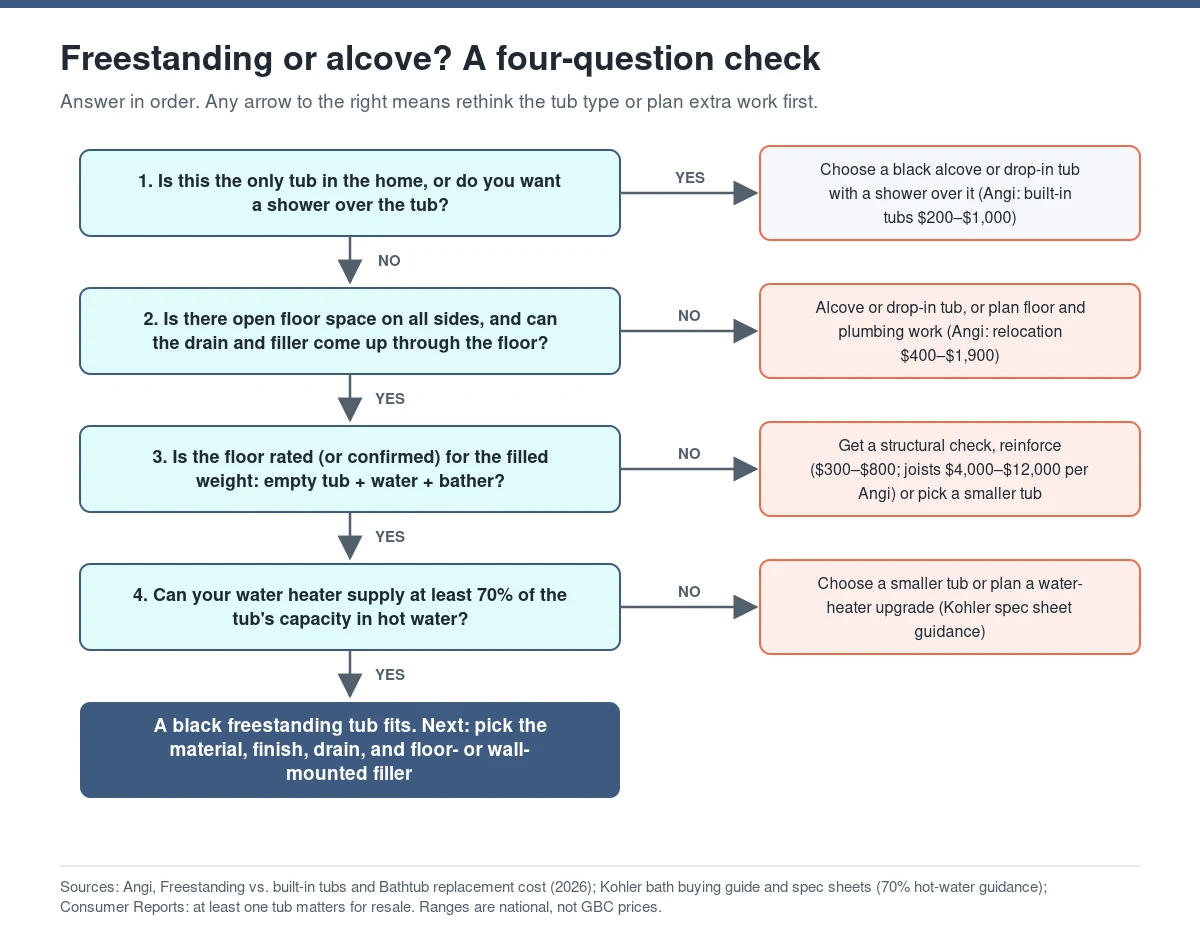
Freestanding tubs make the black finish the centerpiece, because you see the whole shell. Alcove and drop-in tubs show only the interior and maybe an apron, so a black interior matters more than a black exterior. Kohler's buying guide defines bath styles by how they are installed and notes that freestanding baths have a finished exterior.
Black freestanding tub vs. black alcove or drop-in tub
| Question | Freestanding | Alcove / drop-in |
|---|---|---|
| How much black shows | The whole tub; the exterior finish is on display | Mostly the interior, plus an apron or deck edge |
| Shower over the tub | Usually not practical; plan a separate shower (Angi) | Yes, with a surround |
| Plumbing | Drain through the floor; floor or wall filler | Drain and valve on the end wall |
| Ledge for shampoo or sitting | No built-in ledge (Angi) | Deck or tiled ledge possible |
| Typical tub price | $2,000–$3,000 average range; custom up to $9,000+ (Angi) | Built-in $200–$1,000; standard $200–$800 (Angi) |
| Cleaning | Exterior and the floor around and behind the tub | Interior, apron and the caulk line |
Sources: Angi, Freestanding vs. built-in bathtubs; Angi, Bathtub replacement cost; Kohler bath buying guide.
If this is the only tub in the home, or you bathe young children, an alcove tub with a shower over it is usually the practical answer. If the tub sits in a primary bath with a separate shower, a freestanding black tub is where the color earns its keep. Thinking about dropping the tub altogether? Read should you forgo a bathtub in your bathroom remodel? and our walk-in shower vs. bathtub comparison. If you are already planning a tub-to-shower conversion, see replacing your bathtub.
How do you clean a black bathtub without dulling it?
Clean a black tub gently and often: a soft cloth, a mild non-abrasive cleaner, a thorough rinse and a quick wipe-dry. Most damage to dark finishes comes from scrubbing too hard after residue has been allowed to build up.
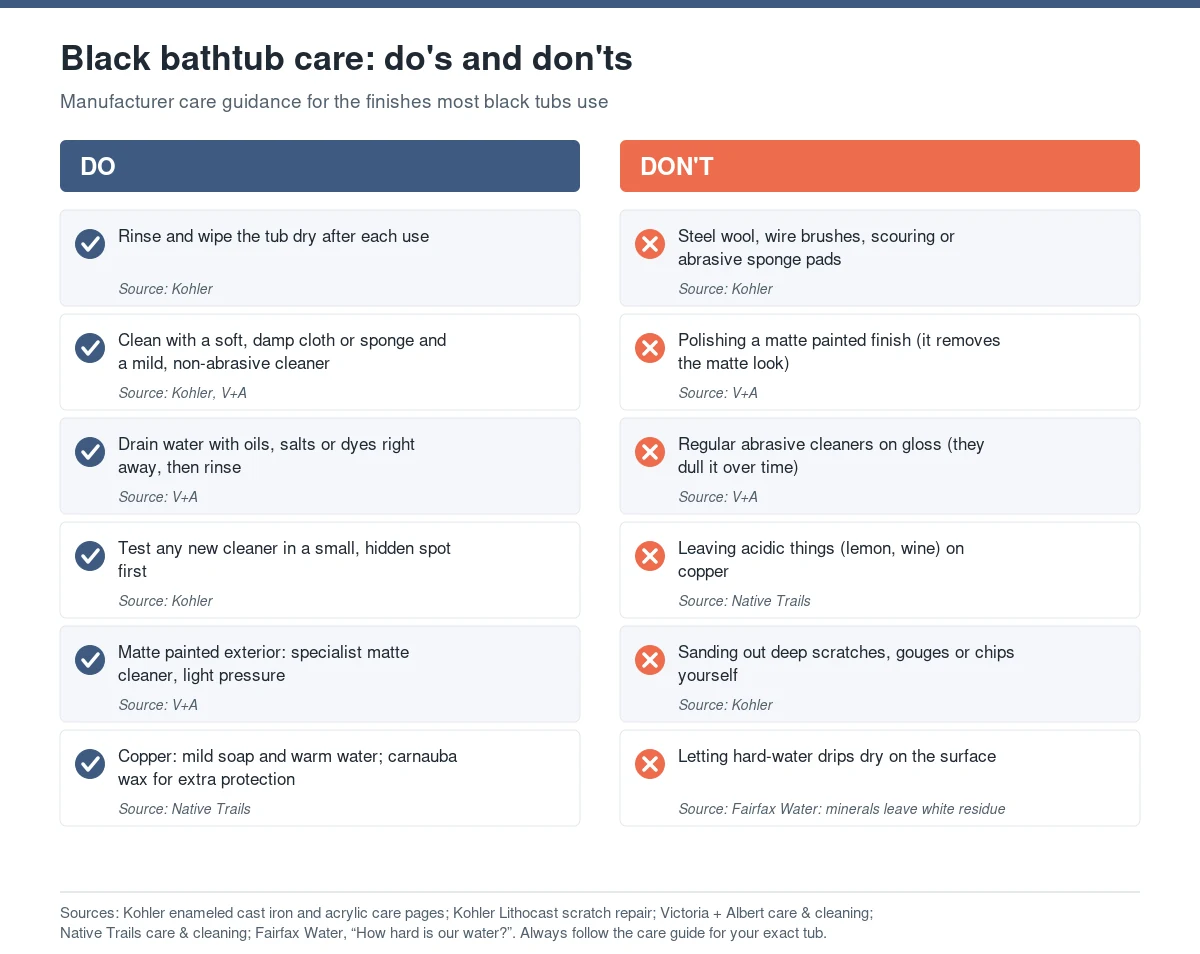
Here is what the manufacturers say:
- Enameled cast iron (Kohler): Wipe with "a soft, damp sponge or cloth" and "never use an abrasive material such as a brush or scouring pad." For rust or stubborn blemishes, use a cast iron cleaner on a wet cloth, rinse thoroughly, then polish with a soft, dry cloth. Kohler's cast iron care page also says to "rinse thoroughly and use a soft cloth to wipe the product dry after each use," to avoid steel wool and wire brushes, and to test any unfamiliar cleaner in a small, hidden area first.
- Acrylic (Kohler's Sterling brand): Wipe down the tub "after each use with soft, damp sponge or cloth." Sterling's acrylic care guide also says never to use brushes or scouring pads.
- Stone resin (Victoria + Albert): Rinse with warm, soapy water. Drain water containing oils, bath salts or dyes and rinse right after use. Move to a mild, non-abrasive household cleaner only when needed.
- Copper (Native Trails): Use mild soap and warm water. "Abrasives should never be used." Carnauba wax adds protection on antique copper.
Hard-water spots on a black tub
Hard water leaves minerals behind when it dries, and those white marks are easy to see on a black surface. This matters locally. Fairfax Water, a major Northern Virginia supplier, describes its water as typically "moderately hard" to "hard" (5 to 10 grains per gallon). It notes that hardness "can cause a build-up of white residue." Prevention works better than removal: rinse the tub and wipe it dry after each bath, the same habit Kohler recommends.
For buildup that is already there, use a cleaner your tub's maker approves for that finish, and test it in a hidden spot first. Be careful with home remedies. Vinegar is acidic, and Native Trails warns that acidic substances alter copper finishes. On painted exteriors, follow the paint maker's instructions rather than a general-purpose bathroom spray. If your water is very hard, ask about whole-house treatment during the remodel, while the plumbing is open.
Can scratches, chips and water spots be fixed?
Usually, yes. How you fix them depends on the material and the depth of the damage. The rule across manufacturers is the same: light damage is a homeowner job, and deep damage is a professional job.
Repair options by material (manufacturer guidance)
| Material | Light scratches or dull spots | Deep scratches, gouges or chips |
|---|---|---|
| Acrylic | White automotive polishing compound rubbed into the area (Sterling) | Not covered by the care guide; ask the maker or a tub repair pro |
| Solid surface (Kohler Lithocast) | Wet-sand with 400-grit, then polish with 600-grit in circles (Kohler) | Not a DIY repair; contact Kohler or a solid surface repair pro |
| Stone resin, gloss (V+A) | Fine-cut automotive compound; if needed, 2000-grit wet paper, then re-polish | Contact the maker's customer care |
| Stone resin, matte (V+A) | Scouring pad with light pressure; if needed, 1500–2000-grit wet paper | Contact customer care |
| Painted exterior (V+A) | Touch-up paint or a touch-up kit from customer care | Contact customer care |
| Enameled cast iron (Kohler) | Cast iron cleaner for stains and rust marks | No home fix on Kohler's care page; ask Kohler or a refinishing pro |
| Copper (Native Trails) | Brightened spots re-patina on their own, usually within days | Contact the maker |
Sources: Sterling acrylic care; Kohler, Remove minor scratching from Lithocast; Victoria + Albert care and cleaning; Kohler cast iron care; Native Trails care.
Two cautions apply. First, V+A's test for "light" is a scratch you cannot feel with a fingernail. If your nail catches, stop and call the maker. Second, sanding a colored or painted surface can cut through the color layer. That is one more reason to confirm, before you buy, whether your black runs through the material or sits on top of it.
What about refinishing? Angi puts professional tub refinishing at about $480, and resurfacing at $330 to $630. It also calls resurfacing "a temporary solution" that may need repeating every few years. Consumer Reports notes that reglazing a dingy cast iron tub can give it "new life for a few hundred dollars." Refinishing an old white tub black is possible, but you get a coating, not a new tub, and it won't last as long as factory enamel.
How do you design a bathroom around a black bathtub?
Treat the tub as the anchor and keep the rest of the room calm enough to let it stand out. Black is a strong color, and the room works best when everything else supports it rather than competing with it.
Fixtures and metal finishes. Black tubs pair with brushed brass or gold for warmth, brushed nickel or chrome for contrast, or matte black for a tonal, all-dark look. Trend data supports softer finishes. In the NKBA's 2026 Bath Trends Report, matte (54%), brushed (51%) and satin (46%) faucet finishes all outranked polished (39%). For a freestanding tub, choose the filler at the same time as the tub. Floor-mounted fillers are themselves sculptural, and their supply lines have to be roughed in through the floor.
Tile. Contrast shows off the tub's outline. White, off-white or light stone floors and walls make a black freestanding tub read like sculpture. For a moodier room, go darker on the walls and use texture rather than color to separate the tub from the background. Large-format tile is a practical match too. The NKBA found that 89% of respondents see homeowners asking for smaller or no grout lines, and 80% expect large-format flooring to be the most popular choice. Fewer grout lines also mean fewer places for soap film to collect around a dark tub.
Wall colors. The NKBA survey found neutrals dominant: off-white (58%), light brown or tan (54%) and white (40%). Black itself scored 18%, and brown-based greens such as sage (64%) and olive (43%) are gaining. A black tub against warm white, greige, sage or olive is a safe, current combination. Warm wood, such as a wood-faced vanity, softens all that black. The same survey found wood-faced vanities (62%) have overtaken painted ones (53%).
Lighting. Black absorbs light. A room that looked bright with a white tub can feel dim with a black one. Layer the lighting: overhead light, task light at the vanity and a dimmable fixture near the tub. In the NKBA survey, 91% named lighting quality a top consideration and 92% said task lighting belongs in every primary bath. Test samples of your tile and paint next to a black finish sample under the actual bulbs you plan to use.
Accessories. Light towels, a wood or stone bath caddy and a plant or two keep a black bathroom from feeling heavy. Brass or nickel hooks and towel bars give you a small dose of contrast that you can change later.
Is a black bathtub a good idea for resale?
A black tub is a style choice, not a mistake, but it appeals to a narrower group of buyers than a white one. The NKBA's 2026 survey of nearly 700 industry professionals found that 96% named neutrals the most popular bath colors and only 18% named black. The same report found that 55% think a larger shower matters more than having a bathtub in the primary bath.
That doesn't mean you should remove every tub. Consumer Reports advises that "if and when you put the house on the market, having at least one tub is important for resale value." Angi's cost guide also notes that "most homebuyers want at least one bathtub." Angi cites the National Association of Realtors' 2022 Remodeling Impact Report, which estimated 71% cost recovery for bathroom renovations.
A sensible strategy:
- Put the black tub in the primary bath and keep a conventional tub-shower in a hall or kids' bath.
- Keep the bold color on the tub and the easy-to-change elements, such as paint, towels and hardware. Keep long-lived surfaces like floor tile more neutral.
- Pick a quality material whose finish can be maintained, so the tub still looks right when you sell.
Are black bathtubs accessible?
A standard freestanding tub, black or not, is one of the harder fixtures to get in and out of. Its walls are high, it has no deck to sit on, and grab bars can't mount on the tub itself. Angi notes that freestanding tubs have no ledge. If anyone in the household has limited mobility, or you plan to age in place, design for it now.
The 2010 ADA Standards apply to public and commercial buildings, not private homes, but they are a useful benchmark. According to the U.S. Access Board's guide to ADA bathing rooms:
- An accessible bathtub has either a removable in-tub seat or a permanent seat at the head end. Seats are 17 to 19 inches high.
- Grab bars go on three walls, and the bars must withstand 250 lb of force.
- Controls sit toward the front, between the rim and the grab bar, so they can be reached from outside the tub. They must work with one hand and less than 5 lb of force.
- A hand-held shower spray is required, and water temperature is limited to 120°F.
- The Access Board suggests that the outside tub wall match seat height for easier transfer, though the standards don't set rim height.
- The guide notes that the ICC A117.1 standard also calls for a vertical grab bar at bathtubs.
In homes, the practical translation is simple. Put blocking in the walls so grab bars can be added later. Choose a tub with a lower rim if you can. Place the filler controls where you can reach them from outside the tub. Kohler's buying guide notes that ADA-compliant baths are available. Angi lists accessible tubs at $4,000 to $12,000 and walk-in tubs at $4,000 to $22,100, for when a standard tub no longer works. Accessibility isn't a style penalty, either. The NKBA reports that 32% of designers already see aging-in-place as mainstream, and another 48% say it is on its way.
Planning a black bathtub in Northern Virginia or Maryland
Local codes, water and housing stock shape a black tub project in the DMV. Settle these questions before you order:
- Which code applies? Northern Virginia jurisdictions enforce the Virginia Residential Code, based on the 2021 IRC, including the Table R301.5 live loads and the P2713.3 tub temperature limit cited above. In Maryland, codes are adopted county by county. Howard County, for example, adopted the 2024 International Residential Code and 2024 International Plumbing Code with local amendments, effective September 7, 2025. Moving a drain or supply line usually means a plumbing permit. Angi puts permit fees at $50 to $500.
- What is under the floor? Many homes have bathrooms on the second floor over finished ceilings. Others sit on slabs or over basements. A freestanding tub with a center drain affects the ceiling below or the slab, so get eyes on the framing early, especially for a 900 lb-plus filled tub.
- How hard is your water? Fairfax Water reports 5 to 10 grains per gallon. In Howard County, public water is purchased from Baltimore City and WSSC, and the source depends on where you live, according to the county's 2026 water quality report. Check your utility's report. Then decide whether gloss (easier to buff) or matte (harder to restore) suits your water and your cleaning habits.
- Is your water heater big enough? Apply Kohler's 70% rule to the tub you are considering before you fall for a 100-gallon soaker.
- Will it fit through the door? A 66-inch cast iron tub weighing nearly 400 lb has to come up the stairs and through the bathroom door. Measure the whole path, not just the bathroom.
For broader budgeting, see our guides to bathroom remodel costs in Northern Virginia and bathroom remodel costs in Maryland, plus small bathroom remodel costs if you are working with a tight footprint.
Planning your black bathtub with GBC Kitchen & Bath
GBC Kitchen & Bath remodels bathrooms across Northern Virginia, Maryland and Washington, DC. Our bathroom remodeling services include freestanding and built-in tubs, custom shower and tile work, vanities, heated floors, custom lighting, accessibility modifications, and the plumbing and electrical relocation behind them. Professional 3D renderings are part of the design work, so you can see a black tub against your chosen tile and wall color before anything is ordered.
GBC takes on bathtub-area projects as well as full bathroom remodels. We don't take fixture-only replacements or repairs, so a black tub with us is planned as part of a bathtub-area or full-bath project. A project manager coordinates the work. Our carpenters and tile installers are GBC employees, and master plumbers and electricians work as specialist subcontractors. Every project follows the same four-step process: initial consultation, design and planning, project execution, and a final walkthrough. The in-home measurement gives you a detailed, itemized estimate.
You can compare tile and bathroom selections in person at our showrooms:
- Alexandria, VA: 5601 General Washington Dr, Unit H, Alexandria, VA 22312 · (703) 750-1188 · Alexandria showroom · Bathroom remodeling in Alexandria
- Ashburn, VA: 44031 Ashburn Shopping Plaza, Suite 275, Ashburn, VA 20147 · (703) 520-7990 · Ashburn showroom · Bathroom remodeling in Ashburn
- Columbia, MD: 9204 Berger Rd, Ste E, Columbia, MD 21046 · (410) 417-6060 · Columbia showroom · Bathroom remodeling in Columbia
Ready to see what a black tub would take in your bathroom? Contact GBC Kitchen & Bath to request an in-home estimate. We'll measure the space, look at the floor and plumbing, and give you an itemized quote.
Sources
- Angi, How much does bathtub replacement cost? [2026 data] (updated Oct. 20, 2026) and Freestanding vs. built-in bathtubs (updated July 8, 2026)
- Kohler, Bath buying guide; Enameled cast iron care; Remove minor scratching from Lithocast
- Kohler spec sheets: K-21000-P5 Artifacts, K-29326-P5 Volute, K-25165, K-24011 Stargaze, K-8333 Memoirs
- Sterling (Kohler), How to clean and care for acrylic bathtubs
- Victoria + Albert, Care and cleaning; spec sheets for Barcelona and Lussari
- Native Trails, Care and cleaning
- Consumer Reports, How to cut bathroom remodeling costs (June 2017)
- NKBA, 2026 Bath Trends Report (Nov. 11, 2025)
- U.S. Access Board, Guide to the ADA Standards, Chapter 6: Bathing rooms
- Virginia Residential Code 2021 via UpCodes, Table R301.5 live loads and P2713.3 bathtub valves
- Howard County, Adopted codes and 2026 water quality report
- U.S. Geological Survey, Facts about water; Fairfax Water, How hard is our water?
