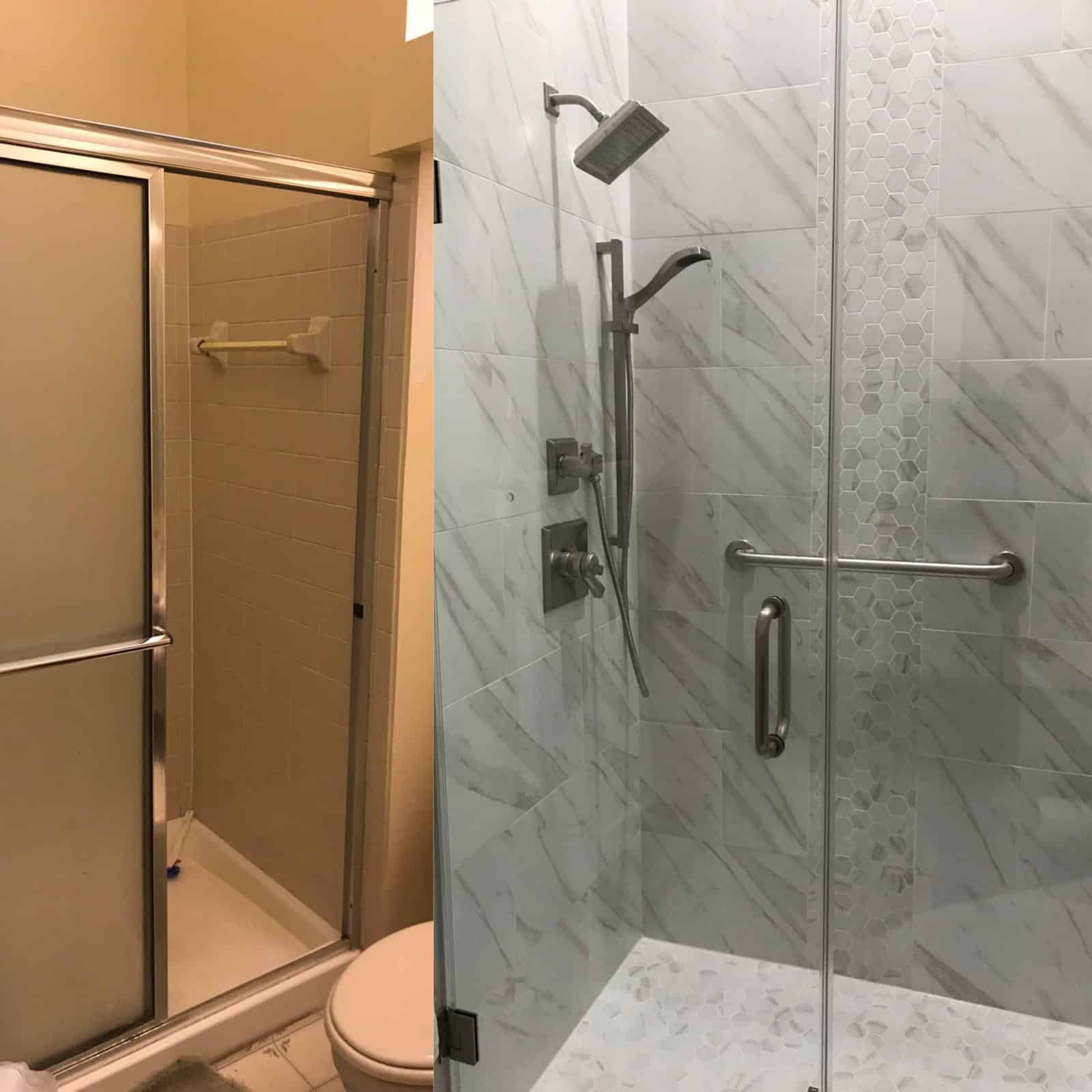
Key Takeaway: Both valve types meet the Virginia Residential Code and both protect against sudden scalding. A pressure-balance valve reacts when water pressure changes, such as a toilet flush, and is simpler and usually less expensive. A thermostatic valve holds a preset temperature and gives finer control, which helps households with children or older adults, but it costs more and can be harder to retrofit.
- Code requires every shower and tub/shower valve to be pressure-balance, thermostatic or a combination, with a limit set so water does not exceed 120°F (P2708.4).
- Pressure-balance: one handle, reacts to pressure changes, the most common choice.
- Thermostatic: separate temperature and volume control, holds a set temperature, more cost and more wall space.
- The valve must be rated for the flow of the shower head you install, so choose the head and valve together.
What Does a Shower Valve Have to Do by Code?
The shower valve sits behind the handle and mixes hot and cold water. Under section P2708.4 of the Virginia Residential Code 2021, individual shower and tub/shower combination valves must be one of three types:
- Balanced-pressure (pressure-balance)
- Thermostatic
- Combination balanced-pressure and thermostatic
The valve must conform to ASSE 1016/ASME A112.1016/CSA B125.16 or ASME A112.18.1/CSA B125.1. It must be rated for the flow rate of the installed shower head and installed at the point of use. It also needs a means to limit its maximum setting to 120°F, and that limit is adjusted in the field following the manufacturer’s instructions.
For a bathtub without a shower, section P2713.3 requires a water-temperature-limiting device that conforms to ASSE 1070, unless the valve is a combination tub/shower valve covered by P2708.4. The NKBA Bathroom Planning Guidelines list the same rules under water temperature safety.
How Does a Pressure-Balance Valve Work?
A pressure-balance valve watches the pressure of the hot and cold supply. As Symmons explains, when cold water pressure drops, for example when someone flushes a toilet, the valve drops the hot water pressure too. That keeps the mix close to where you set it and prevents a sudden burst of hot water.
Most pressure-balance valves have a single handle that controls temperature, and often volume, in one motion. Symmons notes they are the most commonly installed type, easy to use for children or people with arthritic hands, and usually the less expensive option.
What it does not do is read the actual water temperature. If the water heater supply cools or warms, the shower follows it.
How Does a Thermostatic Valve Work?
A thermostatic valve senses temperature and adjusts the mix to hold the setting. Most have separate controls: one for temperature and one for flow or for choosing outlets. You can set a temperature once and leave it, then turn the water on and off with the other control.
According to Symmons, thermostatic valves give finer temperature control and may work well where the supply temperature changes often or sharply. The ability to preset a safe temperature can help older users. Symmons also lists the trade-offs: these valves can cost up to twice as much, they may be harder to fit into small spaces or retrofits, and their internal elements can be affected by mineral buildup and scale.
Pressure-Balance vs Thermostatic: Side by Side
| Feature | Pressure-balance valve | Thermostatic valve |
|---|---|---|
| Meets VRC P2708.4 | Yes | Yes |
| What it reacts to | Changes in supply pressure | Changes in water temperature |
| Typical controls | One handle | Separate temperature and volume or outlet controls |
| Preset temperature | No; set each time | Yes; leave the temperature dial in place |
| Cost | Usually lower | Can be up to about twice as much (Symmons) |
| Retrofit | Often fits the existing wall opening | May need a wider opening or moved plumbing |
| Maintenance | Cartridge service | Thermostatic element can be affected by scale |
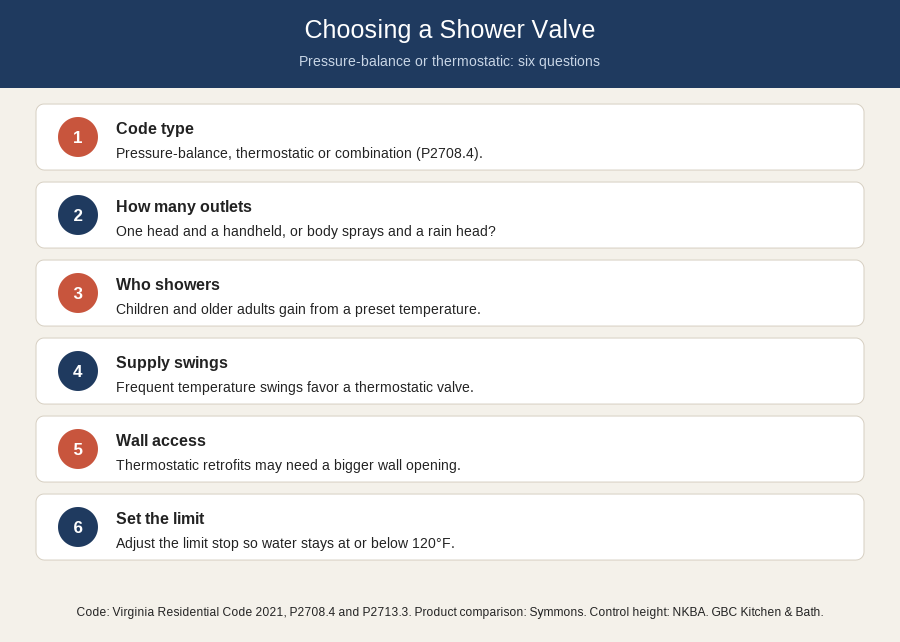
Whichever valve you choose, the 120°F limit still has to be set on site. That limit stop is separate from the temperature setting on your water heater.
Which Valve Suits Your Bathroom?
A pressure-balance valve is a good fit when:
- The shower has one head and maybe a handheld on a diverter
- You want a simple single-handle control
- You are replacing a valve in a finished wall and want to keep the opening small
A thermostatic valve is a good fit when:
- You want separate temperature and volume controls
- Young children or older adults use the shower and you want a fixed safe temperature
- The hot water temperature at your shower tends to swing
- The wall is open during a full remodel, so a larger valve body is easy to place
Handheld showers have their own rule. Section P2708.5 requires them to conform to ASME A112.18.1/CSA B125.1 and to provide backflow protection. If you are adding a handheld for seated showering, our aging-in-place bathroom guide covers bench and grab bar placement. NKBA recommends shower controls between 38 and 48 inches above the floor, reachable from inside and outside the spray.
Replacing a Shower Valve: What Changes?
Changing a handle and trim is simple. Changing the valve body means opening the wall, and in Fairfax County the Plumbing (PLBR) Residential permit page lists replacing or repairing plumbing equipment and fixtures as work that requires a residential plumbing permit. In Montgomery County, Maryland, see the DPS residential alterations page and confirm the plumbing permit path with your plumber.
Because the valve is behind tile, it makes sense to choose it during design, together with the shower head, the niche and the glass. Our guides to walk-in shower design ideas, steam shower planning and frameless vs framed shower doors cover the rest of the shower plan. For budgets, see the bathroom remodel cost guide for Northern Virginia.
Ready to Plan Your Shower?
See our bathroom remodeling service page for the bathroom work GBC Kitchen & Bath offers. When you are ready, contact us with your shower layout and the outlets you want, and we can talk through valve options.
Showroom locations, as listed on the contact page:
- Alexandria: 5601 General Washington Dr Unit H, Alexandria, VA 22312. Phone (703) 750-1188. Hours Monday to Friday 9 a.m. to 6 p.m., Saturday 10 a.m. to 4 p.m.
- Rockville: 1055 Rockville Pike, Rockville, MD 20852. Phone (301) 309-3520. Hours Monday to Friday 9 a.m. to 5 p.m., Saturday 10 a.m. to 4 p.m.
- Ashburn: 44031 Ashburn Shopping Plaza Suite 275, Ashburn, VA 20147. Phone (703) 520-7990. Hours Monday to Friday 9 a.m. to 6 p.m., Saturday 10 a.m. to 4 p.m.
- Columbia: 9204 Berger Rd Ste E, Columbia, MD 21046. Phone (410) 417-6060. Hours Monday to Friday 9 a.m. to 5 p.m., Saturday 10 a.m. to 3 p.m.
Main phone: (844) 644-4422. Email: info@gbcdc.com.
