Howard County is one of Maryland’s most established places to own a home, and many of its houses are now at the age when kitchens and bathrooms get redone. This guide is for homeowners planning a remodel anywhere in the county, from Columbia’s villages to Ellicott City, Clarksville, Fulton, Elkridge and beyond. It covers what the housing data says about local homes, which permits and approvals apply, what remodels typically cost in our region, and how to check that a contractor is properly licensed in Maryland.
GBC Kitchen & Bath serves Howard County from our Columbia showroom at 9204 Berger Road. We have remodeled kitchens, bathrooms and basements across the D.C. region since 2001. Our kitchen, bathroom and basement remodeling projects carry a three-year workmanship warranty, and we hold an active Maryland Home Improvement Commission license, MHIC #135112. Stop by to see cabinetry, countertop slabs and fixtures in person, or request a free in-home estimate.
Howard County at a glance
The figures below come from the U.S. Census Bureau’s American Community Survey (ACS) 2020–2024 five-year estimates, the most detailed recent housing data available at the county and community level.
| Measure | Howard County | Columbia (CDP) | Maryland | United States |
|---|---|---|---|---|
| Housing units | 125,286 | 43,280 | 2,560,784 | 143,775,360 |
| Median year built | 1989 | 1983 | 1979 | 1980 |
| Median value, owner-occupied homes | $597,900 | $497,400 | $419,900 | $332,700 |
| Owner-occupied share of occupied homes | 71.5% | 64.8% | 67.6% | 65.2% |
| Homes built before 1980 | 29.0% | 42.9% | See source | See source |
Source: U.S. Census Bureau, ACS 2020–2024 5-year estimates (tables B25001, B25003, B25034, B25035, B25077), via Census Reporter: Howard County and Columbia CDP. CDP = Census-designated place. Estimates carry margins of error.
Three things stand out. Homes here are worth considerably more than the state and national medians, which affects how much it makes sense to invest in a remodel. Most homes are owner-occupied, so most remodels are done by people who live in the home, which matters for permit rules discussed below. And while the county’s housing is younger than Maryland’s overall, Columbia’s is noticeably older.
What Howard County’s housing stock means for your remodel
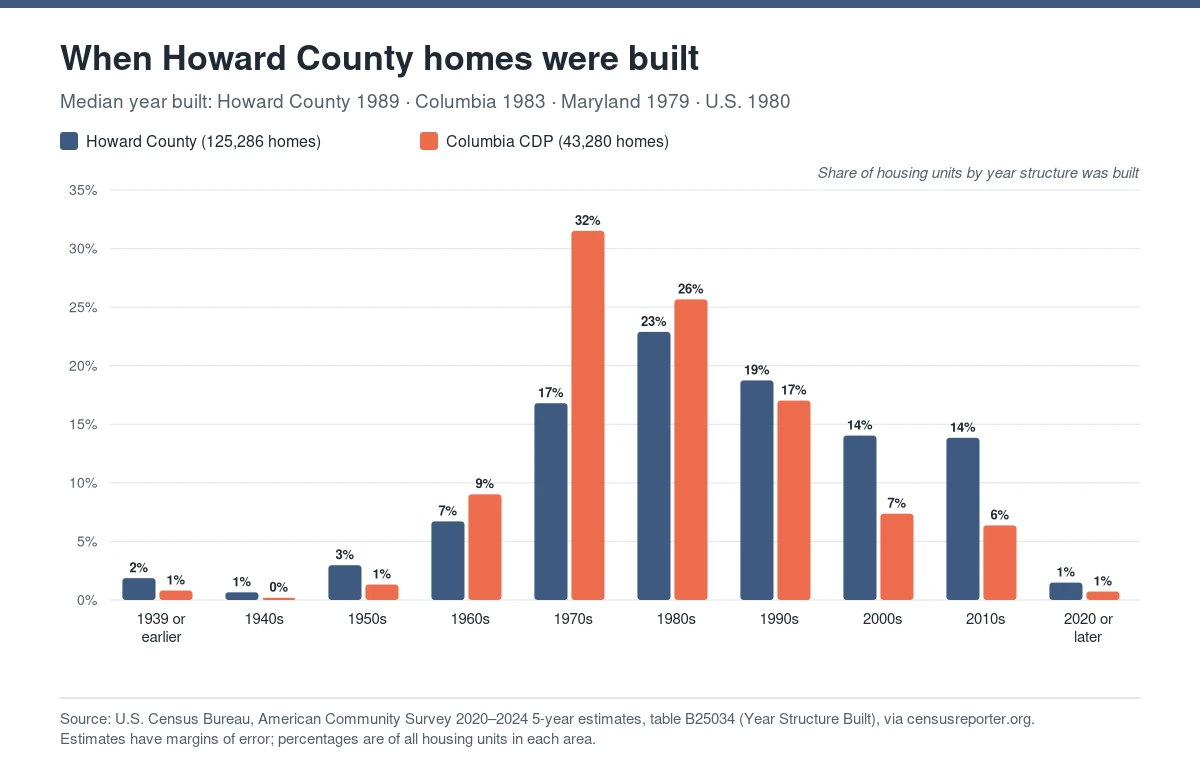
Howard County grew quickly in the late 20th century. Of the county’s roughly 125,000 housing units, about 16.8% were built in the 1970s, 22.9% in the 1980s and 18.7% in the 1990s. Taken together, the 1970s through 1990s account for about 58% of today’s homes. Columbia skews older still: 31.5% of its homes were built in the 1970s and 25.7% in the 1980s.
| Year built | Howard County units | Share | Columbia units | Share |
|---|---|---|---|---|
| 2020 or later | 1,862 | 1.5% | 313 | 0.7% |
| 2010–2019 | 17,347 | 13.8% | 2,755 | 6.4% |
| 2000–2009 | 17,584 | 14.0% | 3,189 | 7.4% |
| 1990–1999 | 23,487 | 18.7% | 7,367 | 17.0% |
| 1980–1989 | 28,675 | 22.9% | 11,107 | 25.7% |
| 1970–1979 | 21,050 | 16.8% | 13,637 | 31.5% |
| 1960–1969 | 8,404 | 6.7% | 3,905 | 9.0% |
| 1950–1959 | 3,718 | 3.0% | 574 | 1.3% |
| 1940–1949 | 820 | 0.7% | 81 | 0.2% |
| 1939 or earlier | 2,339 | 1.9% | 352 | 0.8% |
| Total | 125,286 | 100% | 43,280 | 100% |
Source: U.S. Census Bureau, ACS 2020–2024 5-year estimates, table B25034 (Year Structure Built). Shares may not sum to 100% due to rounding.
Why does age matter? A home built in the 1980s is now around 40 years old. Many have original or once-updated kitchens and baths, plumbing and electrical systems designed for a different era, and layouts that predate today’s open kitchens and larger showers. National research points the same way. Harvard’s Joint Center for Housing Studies reports that the U.S. housing stock had a median age of 44 years in 2023. In 2023, average improvement spending on homes built before 1980 was 24% higher than on homes built since 2010, according to its Improving America’s Housing 2025 report.
Lead paint in older homes
About 29% of Howard County homes, and about 43% of Columbia homes, were built before 1980. That matters because of lead-based paint. The U.S. Environmental Protection Agency’s Renovation, Repair and Painting (RRP) rule requires that anyone paid to disturb painted surfaces in homes built before 1978 be certified and use lead-safe work practices. If your home predates 1978, ask any contractor how they will comply. Census decade groupings don’t line up exactly with 1978, so check your home’s actual year built in your property records.
Townhomes, condos and single-family homes
Howard County’s housing is mostly single-family, but there are plenty of attached homes and apartments. That affects remodeling, because a townhome or condo may need association approval and has shared walls, plumbing stacks or structural elements to consider.
| Type of structure | Howard County | Share | Columbia | Share |
|---|---|---|---|---|
| Single-family detached | 62,770 | 50.1% | 17,080 | 39.5% |
| Single-family attached (townhomes) | 28,061 | 22.4% | 10,993 | 25.4% |
| 2 to 4 units | 2,195 | 1.8% | 825 | 1.9% |
| 5 to 19 units | 19,532 | 15.6% | 9,264 | 21.4% |
| 20 or more units | 11,656 | 9.3% | 5,035 | 11.6% |
| Mobile home, other | 1,072 | 0.9% | 83 | 0.2% |
Source: U.S. Census Bureau, ACS 2020–2024 5-year estimates, table B25024 (Units in Structure).
Howard County’s own residential permit handout tells applicants to upload a “Condo/HOA Approval Letter, if applicable” with many types of building permits. If you live in a townhome or condo community, start the association conversation early.
Howard County communities we serve
Howard County has no incorporated cities or towns, so the county government provides local services everywhere, according to Howard County and the Maryland Manual. That means the same county permit office and building code apply whether you live in Columbia, Ellicott City or a rural crossroads. Communities are Census-designated places or simply mailing-address names, and many residents know them by their ZIP code rather than by Census boundaries. The table below lists the communities where GBC has dedicated pages, with Census data where it exists. Some well-known names straddle county lines; those are flagged.
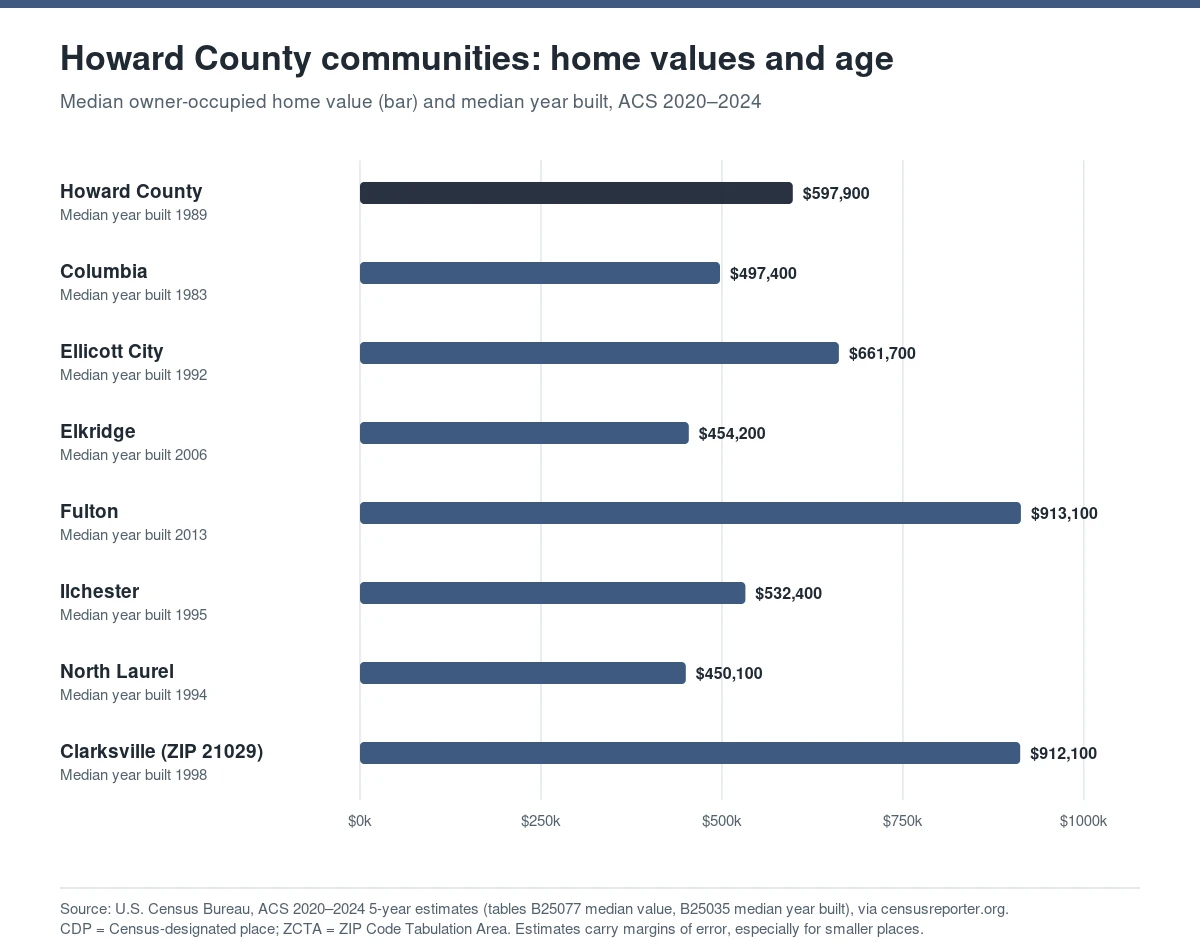
| Community | County status (Census) | Median year built | Median home value | Owner-occupied | GBC pages |
|---|---|---|---|---|---|
| Columbia | Entirely in Howard County | 1983 | $497,400 | 64.8% | Kitchen · Bath |
| Ellicott City | Entirely in Howard County (county seat) | 1992 | $661,700 | 72.0% | Kitchen · Bath |
| Elkridge | Entirely in Howard County | 2006 | $454,200 | 62.3% | Kitchen · Bath |
| Ilchester | Entirely in Howard County | 1995 | $532,400 | 76.4% | Kitchen · Bath |
| North Laurel | Entirely in Howard County | 1994 | $450,100 | 62.3% | Kitchen · Bath |
| Fulton (incl. Maple Lawn) | Entirely in Howard County | 2013 | $913,100 | 79.9% | Kitchen · Bath |
| Highland | Entirely in Howard County | 1994 | Small sample | Small sample | Kitchen · Bath |
| Clarksville (ZIP 21029) | Not a CDP; ZIP area is entirely in Howard County | 1998 | $912,100 | 93.6% | Kitchen · Bath |
| Jessup | Border: split between Howard and Anne Arundel counties | 2003 | $462,000 | 56.2% | Kitchen · Bath |
| Marriottsville (ZIP 21104) | Border: ZIP area spans Howard, Carroll and Baltimore counties | 1995 | $680,200 | 97.0% | Kitchen · Bath |
| Woodstock (ZIP 21163) | Border: ZIP area is mostly in Baltimore County, partly in Howard | 2001 | $602,800 | 85.0% | Kitchen · Bath |
Source: U.S. Census Bureau ACS 2020–2024 5-year estimates via Census Reporter (median year built B25035, median value B25077, tenure B25003); county relationships from Census TIGER geography via Census Reporter. Highland's estimate covers only about 300 homes, so its value and tenure figures are omitted. ZIP figures are ZIP Code Tabulation Areas and can include homes outside the named community.
Border areas. If your address is in Jessup, Marriottsville or Woodstock, your home may be in Howard County or in a neighboring county. That decides which county issues your permits. Check your property tax bill or the Maryland property records before you apply. Savage, Scaggsville and Lisbon are also Census-designated places within Howard County. South Laurel and West Laurel are in Prince George’s County, not Howard County, so the Howard County rules in this guide don’t apply there.
Remodeling in Columbia: village architectural review
Most of Columbia is covered by Columbia Association covenants, administered village by village. Howard County is direct about how this fits with permits. Its notice to permit applicants says that exterior construction or alteration on Columbia Association-assessed property may also require approval from the village’s Architectural Committee. It also says that review is “a completely separate process” from county permits, and that a county building permit “does not eliminate the need” for village approval.
What does that mean for a kitchen or bathroom? The county notice is about changes to the exterior of your property, such as an addition or a deck. A purely interior remodel generally doesn’t change the exterior. But some kitchen and bath projects do. Examples include a new or enlarged window, a new exterior range-hood or dryer vent, a relocated door, or a bump-out addition. If anything visible from outside will change, call your village covenant advisor before you finalize the design. Columbia Town Center’s covenant FAQ says its review process “usually takes at most 3 to 4 weeks.” Other villages set their own schedules.
| Village | Covenant advisor phone |
|---|---|
| Dorsey's Search | 410-730-4005 |
| Harper's Choice | 410-730-3888 |
| Hickory Ridge | 410-730-7327 |
| Kings Contrivance | 410-381-9600 |
| Long Reach | 410-730-8113 |
| Oakland Mills | 410-730-4610 |
| Owen Brown | 410-381-0202 |
| River Hill | 410-531-1749 |
| Town Center | 410-730-4744 |
| Wilde Lake | 410-730-3987 |
Source: Howard County Department of Planning and Zoning. Contacts can change; confirm with your village association.
Outside Columbia, many Howard County neighborhoods have their own homeowners or condominium associations with their own rules. Read your community documents, and ask your association whether it needs to approve contractor parking, dumpsters or exterior changes.
Remodeling in historic Ellicott City
Parts of Ellicott City, including the historic downtown, lie within a county historic district. Under Howard County Code §16.603, a certificate of approval from the Historic Preservation Commission is required before construction, repair or alteration that affects a structure’s exterior appearance. The county’s Ellicott City historic district guidelines state that review “is not required for alterations to the interior of buildings.”
For most kitchen and bathroom remodels, that’s good news: interior work is outside the Commission’s review. If your plan changes a window, door, vent or anything else on the exterior, you’ll need a certificate of approval first. DILP won’t issue a building permit for work that needs one until the Commission has approved it. The county also notes that eligible repairs to contributing historic buildings may qualify for tax credits. Our guide to bathroom remodeling in historic Ellicott City covers what to plan for in older homes.
Permits: working with Howard County DILP
Building, electrical, plumbing and mechanical permits in Howard County are handled by the Department of Inspections, Licenses and Permits (DILP). Here is what homeowners should know.
- Residential building permits are filed electronically. Applications go through the county’s online Citizen Access portal. The county publishes a resources and fees page with handouts, checklists and the current fee schedule.
- Structural changes need drawings. The county’s residential permit handout includes a sample “interior alteration” permit for a first-floor kitchen remodel that removes a load-bearing wall between the kitchen and dining room. For that kind of project, the county lists existing and proposed floor plans, engineering calculations, a plot plan if exterior openings change, and a condo/HOA approval letter if applicable.
- Current codes. Howard County adopted the 2024 International Residential, Building and Energy Conservation Codes and the 2024 plumbing and fuel gas codes, effective September 7, 2025.
- Plumbing permits. The county states that replacing a water heater requires a plumbing permit pulled by a Master Plumber. Kitchen and bath remodels that move or add plumbing likewise involve licensed plumbers and inspections.
- Private well or septic. If your home is on a private well or septic system, the county says Health Department approval may be needed for your project. Its number is 410-313-6300.
- Who can pull permits. Section 105.8 of the county building code lets owners of one- and two-family homes act as their own general contractor for alterations, but only if they own the property and it is their primary residence. Rental properties and homes that aren’t the owner’s primary residence need a contractor with a Maryland Home Improvement or Home Builders license.
Not every remodel needs a building permit. Whether yours does depends on its scope, so call DILP’s Licenses & Permits Division before work starts if you’re unsure. On GBC projects, we apply for the permits and coordinate inspections with Howard County, so approvals aren’t left to you.
| Office | Contact |
|---|---|
| DILP Licenses & Permits Division | 410-313-2455 (option 4) · 3430 Court House Drive, Ellicott City, MD 21043 |
| DILP Inspections & Enforcement | 410-313-1823 |
| Howard County Health Department (well and septic) | 410-313-6300 |
Source: Howard County DILP.
Hiring a licensed contractor in Maryland
Maryland takes home improvement licensing seriously. The Maryland Home Improvement Commission (MHIC) licenses and regulates home improvement contractors. Since July 1, 2016, only MHIC-licensed contractors may contract directly with homeowners; the state eliminated the separate subcontractor license that year. Before you sign anything, know your rights:
- Unlicensed work is a crime, and it leaves you unprotected. MHIC’s consumer advice notes that home improvement work without a license is a criminal offense. A homeowner who hires an unlicensed contractor has no protection from the state’s Guaranty Fund.
- The contract must be in writing. Under MHIC’s contract requirements, it must describe the work and materials and include the contractor’s name, address and MHIC license number. It must state approximate start and substantial-completion dates, and include notices about the Guaranty Fund and your right to buy a performance bond. You must receive a signed copy before work starts.
- Deposits are capped. A contractor cannot accept more than one-third of the contract price as a deposit, and may not take any payment until the contract is signed.
- Financing secured by your home adds protections. If payment is secured by a lien on your home, the contract must say so on the first page, and you have three business days to rescind.
- Ask to see the permit. MHIC advises homeowners to ask to see any required building permit before work starts, and to get a copy of the contractor’s liability insurance certificate.
| Step | What to do |
|---|---|
| 1 | Get the contractor's MHIC license number. It must appear on the contract. |
| 2 | Open the MHIC public license query and search by license number, trade name or contractor name. |
| 3 | Confirm the business name, address and expiration date match the contract. |
| 4 | For complaint history, call MHIC at 410-230-6231 or 1-888-218-5925. |
You can check us the same way. A search for license number 135112 on the MHIC public query on October 26, 2026 returned an active license for General Building Concepts LLC, trading as GBC Maryland, with an expiration date of November 8, 2027.
What does a kitchen or bathroom remodel cost in the Howard County area?
Every remodel is priced on its own scope, so be wary of any single “average” number. The most widely cited independent benchmark is the Remodeling 2025 Cost vs. Value Report, which estimates job costs and resale value for standardized projects in 119 U.S. markets. Howard County falls within its Washington, DC market.
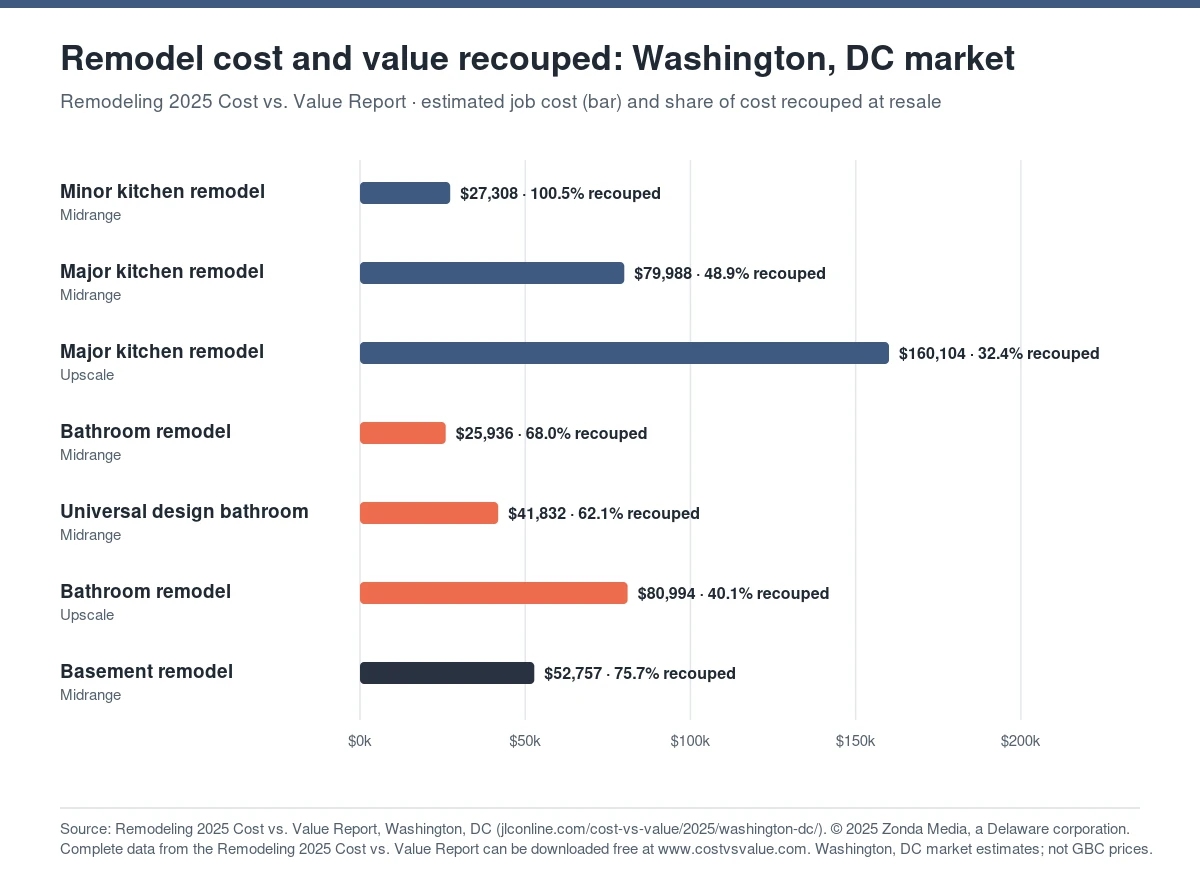
| Project | DC job cost | DC cost recouped | National job cost | National cost recouped |
|---|---|---|---|---|
| Minor kitchen remodel, midrange | $27,308 | 100.5% | $28,458 | 112.9% |
| Major kitchen remodel, midrange | $79,988 | 48.9% | $82,793 | 50.9% |
| Major kitchen remodel, upscale | $160,104 | 32.4% | $164,104 | 35.7% |
| Bathroom remodel, midrange | $25,936 | 68.0% | $26,138 | 80.0% |
| Bathroom remodel, upscale | $80,994 | 40.1% | $81,612 | 41.7% |
| Universal design bathroom, midrange | $41,832 | 62.1% | See report | See report |
| Basement remodel, midrange | $52,757 | 75.7% | $52,012 | 71.0% |
Source: Remodeling 2025 Cost vs. Value Report, Washington, DC. © 2025 Zonda Media, a Delaware corporation. Complete data from the Remodeling 2025 Cost vs. Value Report can be downloaded free at www.costvsvalue.com. Estimates for standardized projects; not GBC prices.
A few takeaways:
- Smaller, targeted updates hold value best. A midrange minor kitchen remodel in the DC market was estimated to recoup about 100.5% of its cost at resale. A midrange major kitchen remodel recouped 48.9%, and an upscale one 32.4%.
- Local costs track national costs closely. For most of these projects, the estimated DC-market job cost is within a few percent of the national figure. For context, the U.S. Bureau of Economic Analysis’s Regional Price Parity for Maryland, which covers overall consumer prices rather than construction, was 105.0 in 2024 (U.S. = 100), according to FRED.
- Resale isn’t the only return. Cost vs. Value measures what a project might add at sale. If you’re staying for years, comfort, function and accessibility matter just as much, and the universal design bathroom figures show what accessibility upgrades cost.
For more detailed planning, see our Maryland kitchen remodel cost guide, our Maryland bathroom remodel cost guide and our granite countertop cost guide. The real number for your home comes from an in-home measurement and an itemized estimate.
Remodeling services for Howard County homeowners
- Kitchen remodeling: design through final walkthrough, with custom cabinetry, countertops, lighting, flooring and appliance installation coordinated by one team. You approve a 3D design of the layout, cabinets and finishes before demolition, and your written proposal includes clear allowances for cabinets, countertops, tile and fixtures. Cabinet lines include Medallion, Forevermark, Waypoint, Fabuwood, Design-Craft, Marsh and Marquis. See local details for Columbia and Ellicott City.
- Bathroom remodeling: powder rooms to primary suites, including custom showers and tile, frameless glass, freestanding or built-in tubs, vanities, steam showers, heated floors, and plumbing and electrical relocation. Shower-only or tub-area remodels are accepted as partial projects. See bathroom remodeling in Columbia.
- Basement remodeling: entertainment rooms, home offices, guest suites, gyms, wet bars and bathroom additions, including waterproofing, framing, electrical and plumbing work. Read about basement remodeling in Columbia.
- Cabinets: new cabinetry for full kitchens, or replacement of two or more cabinets.
- Countertops: granite, quartz, marble and quartzite, with full slabs to view in our showrooms. Countertop replacement is available on its own or as part of a remodel.
Choosing countertops and cabinets
Countertops and cabinets are usually the two biggest material decisions in a kitchen remodel, and both are easiest to judge in person. In our Columbia showroom you can compare cabinet door styles and finishes side by side and see full countertop slabs, not just small samples.
For countertops, granite and engineered quartz remain the most common choices. Consumer Reports’ lab testing rated both Excellent for resistance to cutting, abrasion and heat, with quartz slightly ahead on stains. Installed granite typically runs about $80 to $150 per square foot, and quartz about $50 to $200, according to HomeGuide’s national cost guides. Our granite countertop cost and granite vs. quartz guide walks through the math for different kitchen sizes, plus care, sealing and fabrication-safety questions to ask.
For cabinets, the first question is whether your existing boxes are worth keeping. In older kitchens, original cabinet boxes may be worn or water-damaged, or the layout may no longer suit how the family cooks. Replacement is the route to a new layout, more storage and features like full-extension drawers and pull-outs. Bring your wish list to the showroom, and your designer will show you how each cabinet line handles it.
A note on cabinet refacing in Columbia
Many Columbia homeowners search for cabinet refacing, which keeps the existing cabinet boxes and replaces the doors, drawer fronts and visible surfaces. GBC does not offer refacing or refinishing. We replace cabinets instead, from two or more cabinets up to a full kitchen. Replacement lets you change the layout, fix worn or water-damaged boxes and add modern storage. If you’re deciding between the two, our cabinet refacing vs. replacement guide lays out the differences so you can choose the right kind of provider.
The remodeling process, step by step
GBC follows a four-step process: initial consultation, design and planning, project execution and final walkthrough. A dedicated project manager oversees each job. In Howard County, approvals fit between design and construction.
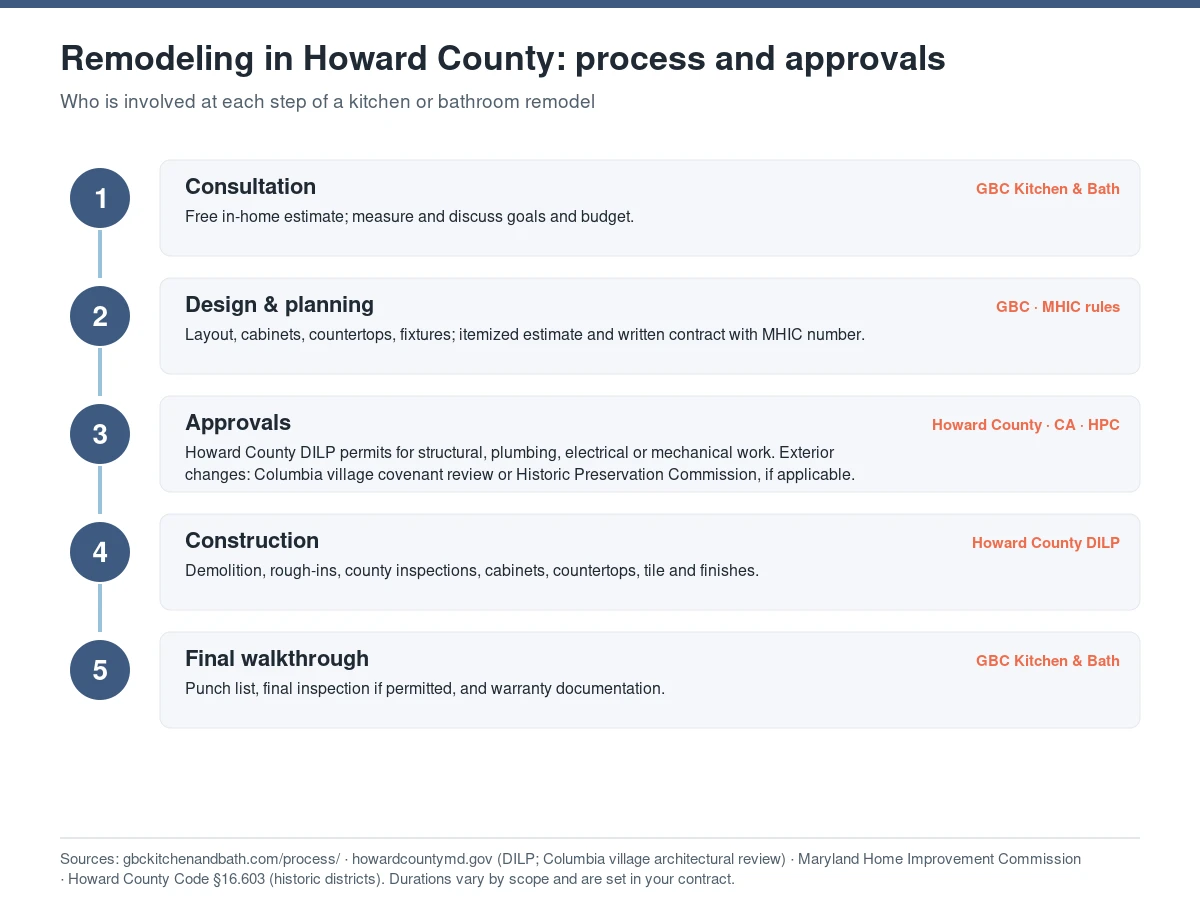
| Step | What happens | Who's involved | Timing notes |
|---|---|---|---|
| 1. Consultation | In-home visit, measurements, goals and budget discussion | Homeowner, GBC designer | Free in-home estimate |
| 2. Design and planning | Layout, cabinet, countertop and fixture selections; itemized estimate; written contract | Homeowner, GBC | Contract must list approximate start and completion dates (MHIC) |
| 3a. Association review (if exterior changes) | Columbia village Architectural Committee or HOA/condo approval | Village covenant advisor or HOA | Town Center: usually at most 3–4 weeks; other villages vary |
| 3b. Historic review (if exterior changes in a historic district) | Certificate of approval from the Historic Preservation Commission | Howard County HPC | Needed before DILP issues a building permit |
| 3c. Permits | Building, plumbing, electrical or mechanical permits as the scope requires | Howard County DILP, licensed trades | Electronic submission; review time varies |
| 4. Construction | Demolition, rough-ins, inspections, cabinets, countertops, tile and finishes | GBC project manager, crews, DILP inspectors | Set in your contract schedule |
| 5. Final walkthrough | Punch list, final inspection if permitted, warranty documentation | Homeowner, GBC | Three-year workmanship warranty on GBC remodeling projects |
Sources: GBC process; MHIC contract requirements; Columbia Town Center covenant FAQ; Howard County Code §16.603.
For a sense of how long the construction phase typically runs, see our guides to how long a kitchen remodel takes and how long a bathroom remodel takes.
Aging in place: accessible kitchens and bathrooms
Older homeowners are a large and growing part of the remodeling market. Nationally, owners age 65 and older contributed 27% of home improvement spending in 2023, up from 14% two decades earlier, according to Harvard’s Joint Center for Housing Studies. The Center’s managing director also named accessibility, along with energy efficiency and disaster resilience, as an area where far more investment is needed.
Accessibility is easiest to build in during a remodel you’re already planning. In a bathroom, that can mean a curbless or low-threshold shower, a built-in bench, blocking in the walls for future grab bars, a comfort-height toilet, slip-resistant tile and lever-style faucets. In a kitchen, it can mean wider walkways, drawers instead of deep base cabinets, and counter sections at different heights. Cost vs. Value’s “universal design bathroom” project, which adds features like these to a standard bath, had an estimated job cost of $41,832 in the Washington, DC market in 2025. It recouped an estimated 62.1% of that cost at resale.
GBC’s bathroom remodeling service includes accessibility modifications where you need them. Tell your designer at the first consultation about anyone in the household with mobility needs, now or in the future, so the plan accounts for them from the start.
What to bring to your first consultation
A productive first meeting saves time later. Have these ready:
- Photos and measurements of the current room, if you have them. We’ll measure anyway, but your notes help.
- Your home’s year built, and whether it’s on public water and sewer or a private well and septic.
- Your association details, if you’re in a Columbia village, an HOA or a condominium.
- Inspiration images of kitchens or baths you like, and a list of what doesn’t work in your current space.
- A working budget range. The Cost vs. Value figures above are a reasonable reality check.
- Your timing, including any dates the room must be usable, such as a holiday or a family visit.
Before you call any contractor: a Howard County checklist
- Confirm your county. If you’re near a county line (Jessup, Marriottsville, Woodstock or the Laurel area), check your tax bill to see which county issues your permits.
- Check your home’s year built. If it was built before 1978, plan for lead-safe work practices under the EPA RRP rule.
- Read your covenants. In Columbia, find your village covenant advisor. Elsewhere, check your HOA or condo documents.
- Note anything exterior. Windows, doors, vents or additions can trigger association or historic review.
- Know whether you’re on well and septic. If so, Health Department review may be needed.
- Verify the MHIC license on the state’s public query, and make sure the number matches the contract.
- Read the contract. Look for scope, materials, dates, the MHIC notices, and a deposit no larger than one-third.
- See the permit before work starts, if one is required.
Visit our Columbia showroom
Our Columbia showroom is the closest GBC location for Howard County homeowners. Compare cabinet door styles, countertop slabs and samples, tile and fixtures, and talk through your project with a designer.
GBC Kitchen & Bath, Columbia showroom
9204 Berger Rd, Ste E, Columbia, MD 21046
Phone: (410) 417-6060
Hours: Monday–Friday 9 a.m.–5 p.m.; Saturday 10 a.m.–3 p.m.; Sunday closed
Get directions · Read Google reviews · Showroom page
Not near Columbia? We also have showrooms in Rockville, MD, Alexandria, VA and Ashburn, VA.
Ready to start? Request your free in-home estimate. We reply within one business day.
Sources
- U.S. Census Bureau, American Community Survey 2020–2024 5-year estimates, via Census Reporter: Howard County, Columbia, B25034, B25024
- Howard County Department of Inspections, Licenses and Permits and permit resources and fees; Residential online building permit handout
- Howard County, Columbia village architectural review contacts; Columbia Town Center, Covenant FAQ
- Howard County, Ellicott City historic district guidelines; Howard County Code §16.603
- Maryland Home Improvement Commission: overview, consumer advice, contract requirements, license query
- U.S. EPA, Lead Renovation, Repair and Painting Program
- Harvard Joint Center for Housing Studies, Improving America’s Housing 2025
- Remodeling, 2025 Cost vs. Value Report, Washington, DC
- U.S. Bureau of Economic Analysis, Regional Price Parities: Maryland (FRED)
